

With finals just weeks away, it’s essential to make the most of your time. Here are some time management hacks to help you stay on track and crush it during finals week.
Time block your schedule
First things first — figure out how you are spending your time. Create a master schedule, including all your remaining classes, finals, meals, exercise and sleep. Once all those activities are accounted for, figure out when you will study and block it into your calendar. State the class you will study for and when you will study (e.g., study Contracts from 2:00 –5:00 p.m.).
“Work backwards” to plan your study blocks
You do not have to treat all classes equally. Once you have your final exam dates in your calendar, you can plan how many study blocks you need for each class and work backwards to fit them in your schedule. For example, maybe you need four study blocks for Torts but only three for Property. Be strategic about your exam study schedule, taking into account your strengths and weaknesses.
Study for no more than two classes per day
Plan to study for no more than two classes a day. For example, you might study Torts from 9 a.m. – 1 p.m. and Criminal Law from 2 – 6 p.m.. These longer study blocks will give you time to dive deep into the subject. On the day before a final exam, plan to study for only that final. You will be too distracted to focus on other final exams.
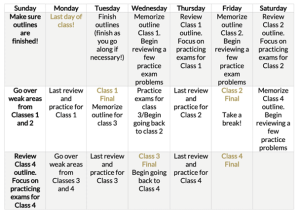
Here’s an example of a study schedule.
Focus on learning the law and taking practice exams
Each morning, write down everything you need to get done during your study blocks. The best tasks to prioritize, in general, are creating and learning your outlines and taking practice exams. Break things down into bite-size steps so it doesn’t feel so overwhelming. For example, maybe you learn five pages of your Torts outline at a time in the morning and take a practice exam in the afternoon. A daily to-do list helps you stay organized and gives you a quick win when you cross things off.
Prioritize harder tasks
It’s easy to put off the hard stuff, but tackling the most challenging tasks first will clear up mental space. Take the big, scary stuff off your plate early in the day. If you struggle with a certain subject, study it first. If you particularly dread memorizing the law, start with that. You’ll feel better once it’s out of the way, and you’ll have more energy to focus on other tasks. If it’s something really tough, break it into smaller tasks so you don’t get stuck. For example, rather than tackling an entire practice exam in one sitting, divide it up so you take it question by question.
Limit or eliminate distractions
The last thing you need during finals is distractions. Put your phone on airplane mode or turn off notifications to minimize interruptions. Remove social media apps from your phone if necessary. Even though social media feels like a good way to unwind, it often leads to endless scrolling, which wastes time. Create a distraction-free study zone, maybe the library, a quiet café or just a clean desk at home.
Find your productive environment
Whether it’s the library, your room or a coffee shop, figure out where you work best. Sometimes it’s not about the space itself, but the vibe it creates. Experiment with different environments and see where you’re most productive. Some days you’ll need total quiet, while other days you might prefer a bit of background noise.
Don’t forget to prioritize breaks, sleep and mental health
Your brain needs rest. Be sure to schedule breaks into your study routine. You don’t have to study for hours straight — take a 5–10 minute break every hour or so. Use this time to stretch, grab a snack or even go for a walk. Taking breaks will keep you refreshed and help you absorb what you’re learning. Similarly, make sure you are sleeping enough (it will help you focus and remember what you studied) and take care of your mental health. You will not perform well on your exams if you are sleep-deprived and burnt out.
