
Alexa is listening. Your phone knows where you’ve been. A simple search on Google, and your data is stored, tracked and analyzed. The question isn’t whether your information is being collected — it’s who’s using it, and how.
For attorneys like Diana Iketani Iorlano, those questions have become a full-time practice. The California attorney and founder of Iketani Law in El Segundo launched her boutique firm in 2018 to focus on data privacy and cybersecurity — a space that has rapidly evolved alongside new technology and regulation.

“I wanted to focus on this area of law and create an avenue for myself to expand into an area I found fascinating,” she said. “What I love about my practice is that there is new law nearly every week; we are constantly learning and changing and being business partners with our clients.”
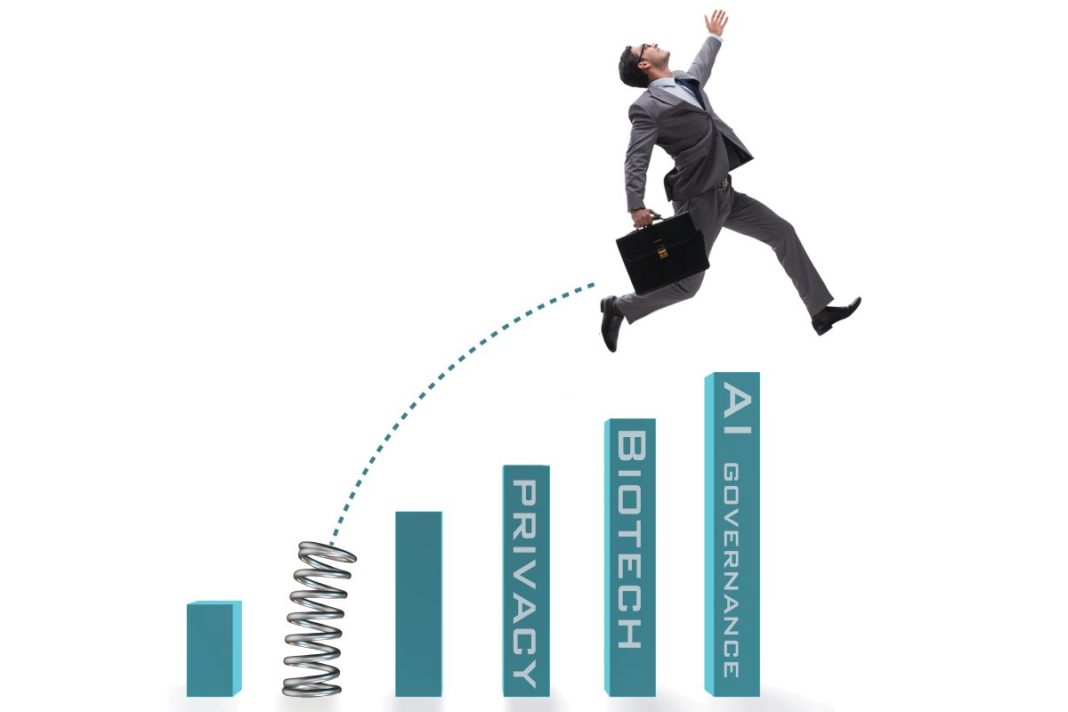
Her story mirrors what’s happening across the profession. The traditional map of practice areas is being redrawn. Artificial intelligence, data privacy, biotech, climate law and immigration are no longer “emerging” frontiers; they are active battlegrounds for regulation, compliance and innovation.
At the same time, evergreen areas like litigation and labor and employment law are being infused with new dimensions, from workplace technology disputes to hybrid work policies. The future, it seems, belongs to lawyers who can combine doctrinal mastery with practical experience and technological literacy.
To get a pulse on what’s driving demand and where to look to build a legal career, The National Jurist spoke with three leading voices shaping legal education and employment trends: Trevi Grant, assistant dean of student career success and employer relations at Sandra Day O’Connor College of Law at Arizona State University; Jim Walsh, assistant dean of career services at Temple University – James E. Beasley School of Law; and Jamy Sullivan, executive director of the legal practice at talent solutions and business consulting firm Robert Half. Together, they painted a picture of a profession both evolving and expanding, where curiosity, flexibility and skill depth are the new currency.
Year of governance
If 2024 was the year everyone started talking about AI, 2026 is the year law will have to govern it.
“Governments and large employers are actively creating AI-specific guidance, enforcement expectations and procurement rules,” Grant said. “Lawyers who understand AI risk governance and contracting will be in demand.”
Her assessment is echoed by Jamy Sullivan, who describes AI governance as one of the “hottest emerging specialties” in Robert Half’s 2026 Salary Guide.
“We can’t go a day without hearing about AI implementation and legal technology,” she said. “Legal employers are willing to pay more for skill sets tied to AI governance, data analytics and technology integration.”
In fact, 79% of legal managers surveyed by Robert Half said they are ready to offer higher salaries for specialized expertise. Firms are increasingly looking for attorneys who can help clients navigate the regulatory gray zones of AI use from algorithmic bias and data transparency to intellectual property concerns surrounding AI-generated content.
And the trend isn’t confined to tech giants. Financial services firms, health care providers and even municipalities are building AI policies that require in-house legal oversight.
“Students who can pair their legal training with technical literacy and regulatory experience will be the most marketable,” Grant said.
The new currency of trust
Hand in hand with AI comes another booming field: data privacy and cybersecurity. For several years, privacy law has been on the upswing, but in 2026, its scope and salary impact are expanding.
“Data privacy is no longer just about compliance checklists,” Grant said. “It’s about risk management, consumer protection and cross-border data flow, all of which require lawyers who understand both the technology and the law.”
That’s exactly the space Iorlano works in. Her firm helps companies manage data ethically and draft clear, transparent privacy policies.
“AI is like the Wild West,” she said. “Businesses will need to understand the privacy implications of their data collection, how they may be processing and using data, how to provide transparent disclosures about data use, and how to implement principles of data minimization.”
Jim Walsh has seen a similar surge of student interest.
“Given the exploding necessity of data privacy and cybersecurity on the industry side and the growing regulatory framework on the government side, students are realizing how important this area has become,” he said. “It’s one of the best ways for law graduates to stay connected to technology without needing a science or engineering background.”
Sullivan noted that legal employers are also differentiating between related skill sets such as data management, contracts management and information governance.
“Companies are paying higher salaries for roles like contracts management, up 2.7% year-over-year, simply because the contract volume and complexity have increased,” she said.
For students, these numbers signal a powerful opportunity: developing privacy certifications or hands-on experience with data compliance tools could be the differentiator that lands a first job.
A biotech boom
Health care and life sciences law have long been robust, but the recent explosion of digital health, telemedicine and biotech innovation has fueled growth.

“Health care, life sciences, biotech and digital health — these are all converging,” Grant said. “The mergers and acquisitions, the regulatory complexity and the litigation risk around drug development and reimbursement all create sustained demand for health care attorneys.”
She emphasized that this field rewards interdisciplinary preparation.
“For students interested in biotech IP, even undergraduate lab familiarity can make a difference,” she said. “Adding that science exposure early on helps candidates stand out, especially now that the recruiting timeline has moved up so much.”
Walsh agreed, noting that insurance litigation and compliance in health care remain “big draws” with a seemingly endless flow of disputes. As the health care industry grows more data-driven, the intersection of privacy, cybersecurity and health care regulation will only deepen.
Issue-driven practice areas
Climate law is seeing a generational surge.
“Environmental law has always been on the horizon,” Grant said, “but now it’s a hot area because of new regulation, clean energy projects and litigation risk around sustainability.”
She points to a dual demand — public and private — as drivers of growth. Government agencies need lawyers for enforcement, while private firms need expertise in project finance, permitting and regulatory advocacy.
At Temple Law, Walsh has observed a related spike in interest around “issue-driven” law, which are areas motivated by social and political debates.
“In an election year, we tend to see an uptick in applicants who are inspired by policy issues,” he said. “Environmental law and immigration law are two of those areas that consistently attract students who want to make a difference.”
The private sector is reinforcing that momentum. Energy transition projects, carbon credit markets and ESG (environmental, social and governance) reporting all require new layers of compliance and disclosure. For students, sustainability isn’t just a value; it’s a viable career.
Compliance and investigations
Every new regulation, whether it involves data, health care or environment, generates compliance work.
Grant said that regulatory enforcement and internal investigations are keeping firms and agencies equally busy.
“There’s demand for attorneys who can lead internal investigations, design compliance programs and navigate enforcement,” she said. “As regulators step up activity across data privacy, competition, antitrust, financial services and health care, compliance lawyers are indispensable.”

Sullivan added that risk management and compliance roles are also evolving on the corporate side.
“These aren’t new fields, but they look different now,” she said. “Automation and AI integration have changed what compliance and contracts management mean; it’s about how companies use technology to stay ahead of risk.”
Notably, 45% of legal hiring managers in Robert Half’s survey said they expect adding new benefits and perks to be an effective recruiting strategy in 2026, a nod to the competition for compliance professionals.
Evergreen with a twist
Even as newer practice areas grab headlines, traditional fields like labor and employment continue to thrive and adapt.
“Labor and employment law has been in the headlines consistently, particularly since COVID,” Sullivan said. “Each state’s rules are a little different, and if a business operates across state lines, that complexity ensures steady demand for employment lawyers.”
From hybrid work arrangements to AI in hiring, new workplace technologies are creating uncharted territory for employment law. Add to that the proliferation of state-specific wage transparency and leave policies, and the practice is anything but static.
Litigation, too, remains “evergreen,” Sullivan said. This is an essential counterbalance in any economic cycle. As she puts it: “Counter-cyclically, litigation continues to be a hot practice area. Every economic shift brings disputes.”
Frontier practice fields
One unexpected area of steady growth: cannabis law.

“With more states legalizing marijuana use, there’s a whole new sector of legal business growth,” Walsh said. “But because it remains illegal at the federal level, it creates a very unique landscape of legal issues.”
From licensing and taxation to real estate and employment, cannabis practice intersects with multiple other areas of law, creating rich opportunities for lawyers comfortable with regulatory gray zones.
Walsh said that there is a rising interest in international trade law, especially as global supply chains and sanctions regimes evolve, and in “J.D. advantage” careers such as compliance, risk management and operations.
“We’re seeing more students explore roles where a J.D. is beneficial, even if they’re not practicing attorneys,” he said. “Partly because those opportunities are growing, and partly because federal government hiring has slowed.”
Skills with staying power
Despite economic fluctuations, corporate and transactional work remains a foundation for legal employment.
“There’s still deal-driven hiring in many markets,” Grant said. “Transactional skills are portable across industries like tech, health care and energy.”
Robert Half’s 2026 Salary Guide supports that point, as Sullivan noted that overall attorney pay is projected to rise 1.5% in 2026, with transactional lawyers among those best positioned to benefit from increased deal volume as interest rates stabilize.
For students, transactional law offers a chance to blend legal strategy with business acumen and to future-proof a career with skills that transfer across sectors.
Preparing for the future
For all three experts, the message to students is consistent: Start early, go deep and gain real experience.
Grant’s office at ASU Law places more than 200 students in externships every semester, and she believes those experiences are game changers.
“Clinics, externships and internships often make the difference in hiring,” she said. “We allow up to 12 credits in externships and 12 in clinics because experiential learning gives students an edge before they ever reach the job market.”
She also stressed that technology is no longer optional.
“Deep doctrinal knowledge is important but pairing that with technical or regulatory literacy makes a candidate stand out,” she said.
Sullivan agreed.
“I’ve heard that law schools are adding AI components to their courses and teaching how to integrate AI in legal work,” she said. “That’s a great response to what employers want. Graduates who already have those skills will be more competitive.”
Even small additions can pay dividends.
“If you’re interested in privacy, a certification helps,” Grant said. “I emphasize that if you’re drawn to biotech IP, some lab familiarity helps. The point is to show commitment and curiosity early.”
University of California, Berkeley, School of Law is leading the way on the AI front. One year after launching the world’s first LL.M. Certificate in AI Law and Regulation, the school has expanded its curriculum with new courses in biotechnology, business and corporate strategy.
“Berkeley Law has always stood for excellence, community and public mission,” said Dean Erwin Chemerinsky. “Our AI Law and Regulation program reflects those values. It’s been immensely popular, and we’re proud to see how students from around the world are finding such value in it as we expand our offerings.”
Part of Berkeley’s executive-track LL.M., the program can be completed online with a summer in residence or over two summers in Berkeley. Courses cover privacy, intellectual property, algorithmic bias and frameworks such as the EU AI Act.
“Artificial intelligence is reshaping nearly every area of human activity, from the courtroom to the marketplace,” said Colleen Chien, professor and co-director at the Berkeley Center for Law & Technology. “At Berkeley Law, we’re preparing lawyers to engage with these changes thoughtfully and rigorously — understanding both the promise of innovation and the need to safeguard rights, equity and accountability in how these systems are designed and governed.”
Since its 2024 debut, the program has drawn lawyers from more than 40 countries, many of whom now advise global firms, governments and NGOs on responsible AI policy.
Gauge interest with trends
While the 2026 landscape is rich with opportunity, experts also caution students not to chase trends blindly.
“There will always be a need for good criminal lawyers and appellate advocates,” Grant said. “Those areas remain strong for students who are passionate about them.”
The key, said Walsh, is to find alignment between what’s growing and what resonates personally.
“Students are motivated by issues,” he said. “That’s what keeps them engaged.”
As the profession moves deeper into the digital and data age, one takeaway stands out: adaptability will define success. Whether advising on AI ethics, investigating compliance breaches or drafting climate-related contracts, tomorrow’s lawyers must balance precision with perspective.
For today’s law students, that means blending the best of both worlds: the timeless rigor of legal reasoning and the nimble curiosity to tackle what’s next.
Tomorrow’s lawyer
If the 2010s were about specialization and the early 2020s about adaptation, 2026 will be about integration: integrating technology, ethics and human insight into every aspect of practice.
For Iorlano, that balance defines the future.
“I tell new lawyers they are the ones who will be making the laws in privacy and cybersecurity,” she said. “So if something does not sound right or is not legislatively correct, they are the ones that can make that change.”
That outlook echoes across the industry. Law students entering today’s market aren’t stepping into a static profession — they’re stepping into one being rewritten in real time.
Or as Grant put it: “Students who take advantage of experiential learning and combine it with curiosity about technology and regulation will be the ones everyone wants to hire.”
And for lawyers like Iorlano, already shaping the frontlines of privacy and AI law, the future is here — and it’s evolving by the week.
