

Picture this: It is July 2026, and instead of filling out bubble sheets and flipping through paper pages, bar exam takers are typing, scrolling and citing legal authorities on their laptops. The NextGen Bar Exam — the first full redesign of the test in decades — is almost here.
Launched by the National Conference of Bar Examiners (NCBE), the NextGen Bar Exam aims to bridge the gap between law school and legal practice by testing not only legal knowledge but also the ability to apply it.
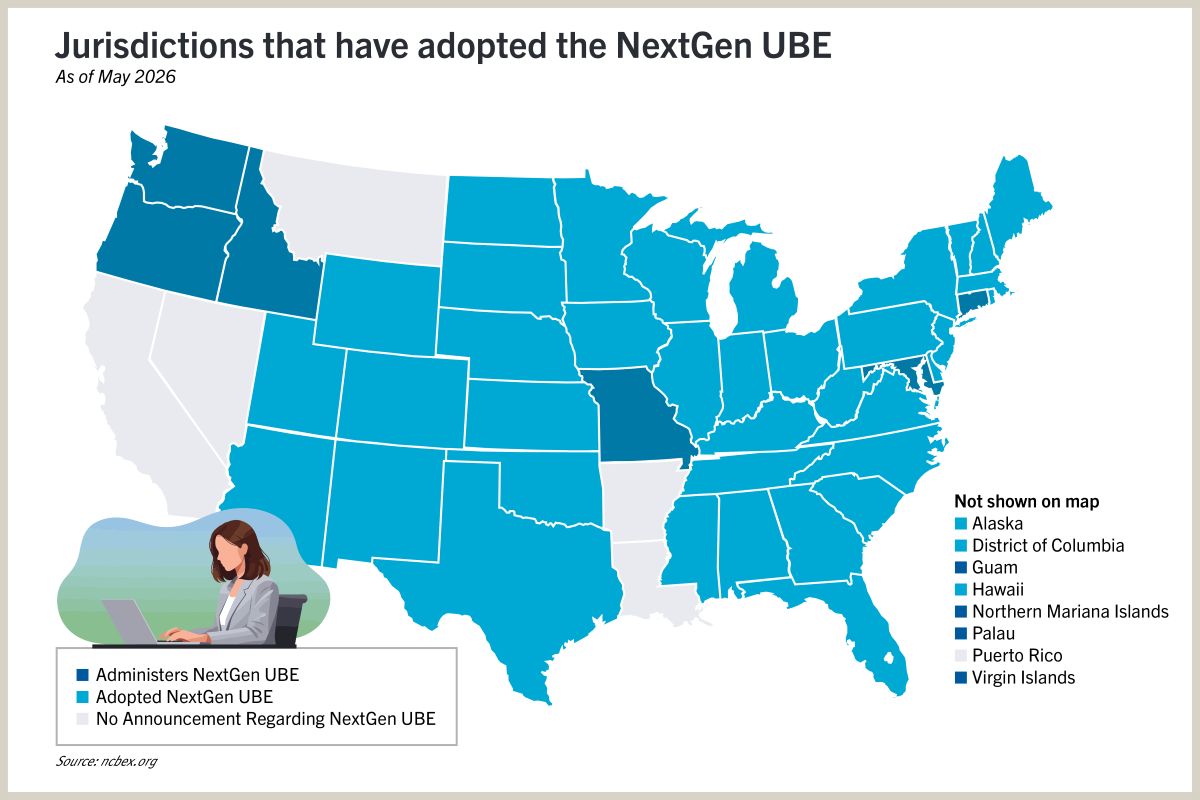
The first administration of the NextGen Bar Exam will debut in July 2026, with the Uniform Bar Exam (UBE) being phased out entirely by July 2028. (Note that the terms the NCBE uses for these exams are “NextGen UBE” and “Legacy UBE.”)
The NCBE has released outlines and sample questions that offer a glimpse of what is coming.
Law schools and students know more than they did a year ago, but there is still plenty of mystery surrounding the biggest change to bar testing in a generation.
Narrow, more focused exam
The NextGen exam will cover fewer subjects than the UBE — just eight core areas: Business Associations, Civil Procedure, Constitutional Law, Contracts, Criminal Law, Evidence, Real Property and Torts.
Some subjects, such as Family Law and Trusts and Estates, will appear only in limited form at first, with Family Law moving into the core group in July 2028.
The scope change signals a move away from breadth and toward greater emphasis on mastery of the foundational subjects the NCBE views as most essential for entry-level practice.
Law with resources (sometimes)
Unlike the UBE, the NextGen Bar Exam won’t always demand total recall. For certain subjects, examinees will be provided with legal resources — statutes, case excerpts or procedural rules — just as practicing lawyers would have on the job.
The NCBE’s scope outlines divide topics into two categories: those that must be known from memory and those that may appear with provided materials or that examinees need only to issue spot. The focus is more on understanding and application rather than memorization.
A redesigned exam format
The NextGen Bar Exam will be shorter than the current UBE, lasting nine hours instead of 12. It will be divided into three three-hour sessions: Tuesday morning, Tuesday afternoon and Wednesday morning.
Each session will include multiple-choice questions, integrated question sets and a performance task. Each session will test both legal knowledge and foundational skills, creating a more uniform experience across the entire exam.
Multiple-choice questions
The multiple-choice portion will remain a major component of the NextGen Bar Exam, accounting for about half of the total score, similar to the Uniform Bar Exam.
Examinees will answer 120 multiple-choice questions. Some questions may include six answer choices with two correct answers rather than one.
Multiple-choice questions will appear not only in their dedicated portion but also within integrated question sets and performance tasks. This expanded use underscores how central multiple-choice questions remain to the new exam, even with the new structure — perhaps more than many expected from a test intended to be significantly different from the UBE.
Integrated question sets
Integrated question sets are one of the most talked-about parts of the NextGen Bar Exam. Each set revolves around a common factual scenario and requires examinees to analyze client problems, interpret legal materials and recommend actions.
Some integrated question sets will use short written responses combining writing with multiple-choice items. They may include excerpts from statutes or cases, testing not only what examinees know but also how they navigate information. Other integrated question sets focus on drafting or redrafting documents. Integrated question sets make up roughly one-fifth of the total score.
Performance tasks
The performance task section will feel familiar to anyone who has studied for the UBE. Some NextGen Bar Exam performance tasks are modeled on the UBE’s performance tests, which simulate real-world assignments such as drafting a client memo or persuasive brief. Other tasks focus on testing the examinee’s ability to conduct legal research, including short answer and multiple-choice questions, in addition to a longer writing task.
On the NextGen Bar Exam, this section now makes up 30% of the total score — an increase from 20% on the UBE — and appears more often. Examinees will complete three shorter performance tasks, one per session, rather than two longer ones. Each performance task will last 60 minutes instead of 90.
Scoring and exam software
Scores will be reported on a 500–750 scale, and each jurisdiction will continue to set its own passing score.
The biggest change is not scoring; it is delivery. Examinees will take the NextGen Bar Exam in person on laptops using a secure browser that allows for highlighting, note-taking and split-screen viewing.
While this shift in testing procedure sounds modern, it also raises concerns.
Administering a high-stakes national exam on personal laptops across jurisdictions carries risks of software crashes, connectivity issues and accessibility problems.
California’s recent struggles with remote testing highlight just how complicated administering large-scale digital exams can be and what needs to be corrected. The NCBE’s administration of the first NextGen Bar Exam in July 2026 will need to be seamless to earn examinees’ confidence.
When and where the launch is
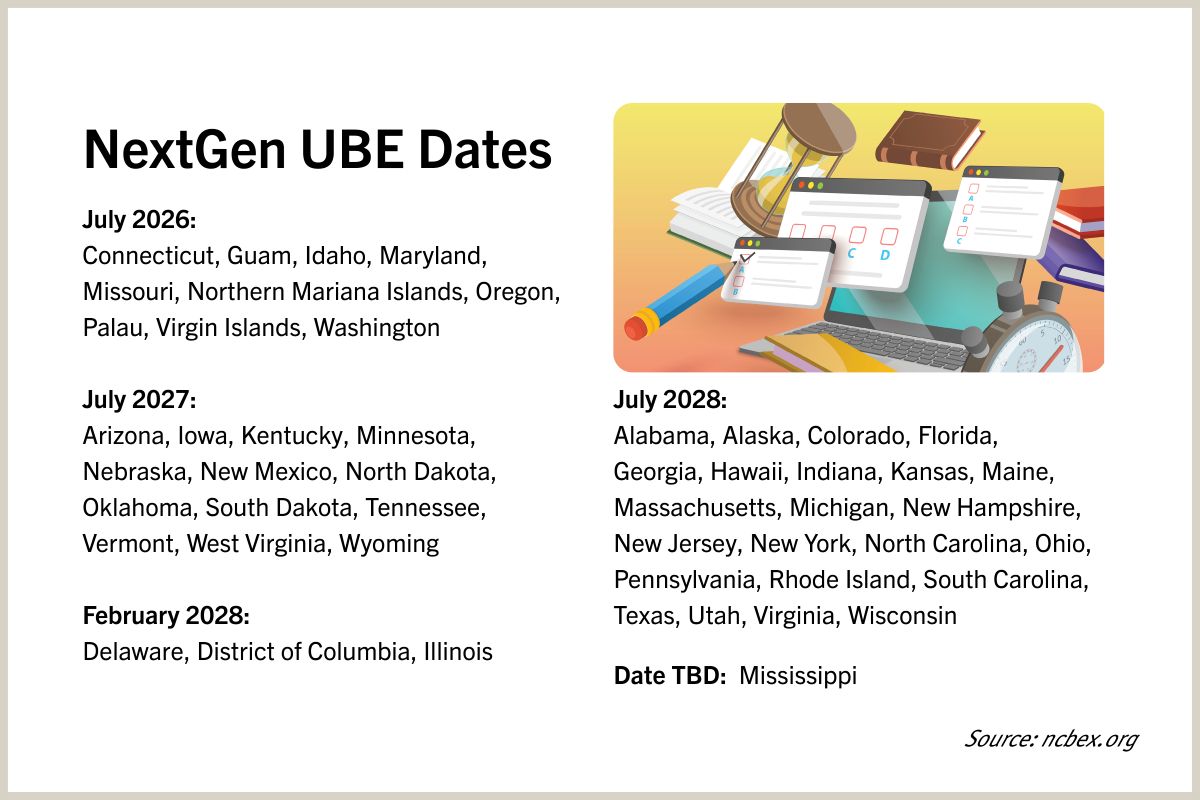
The transition will happen in stages. The first jurisdictions scheduled to administer the NextGen Bar Exam in July 2026 include Connecticut, Maryland, Missouri, Oregon, Washington and several U.S. territories.
In July 2027, Arizona, Minnesota, Kentucky and Tennessee will join.
By 2028, many of the nation’s jurisdictions will have transitioned to the new exam, including New York, Florida, Texas, Massachusetts, the District of Columbia, Pennsylvania, Georgia and Illinois, among others.
This phased rollout means that for several cycles, law school graduates will face different bar exams depending on their jurisdiction. This is a key consideration for anyone planning to transfer scores or seek admission to the bar in multiple states.
How to prepare
The best preparation starts long before bar exam study. The NextGen Bar Exam will test not only what you know, but how well you can use that knowledge to solve legal problems. This means that focusing on foundational courses — Contracts, Torts, Criminal Law, Civil Procedure, Evidence, Constitutional Law, Property and Business Associations — remains as critical as ever. But it is also important to participate in skills-based learning: legal research and writing, client counseling, negotiation and analysis-driven clinics or externships.
What it all means
The NextGen Bar Exam refines rather than replaces the UBE model. It will continue to test core legal knowledge, while implementing new structures and a stated goal of better integration of analysis and skills. But that goal brings both promise and risk.
Law schools will need to adjust how they teach. Bar exam review companies will need to adapt how they prepare students. And students — the ones caught in the middle — will have to navigate this change in real time.
It is an experiment on a national scale. For now, it remains to be seen how much the new format will truly differ in practice. What is certain is that law students will still need to know the law, think critically under time pressure and communicate clearly — just as they always have.
