

Health care is big business, and it’s constantly changing. New medicines and medical devices enter the market, regulations change and artificial intelligence is quickly changing the health care landscape. Ads for prescription drugs and health products are everywhere, while debates over access to care continue to make headlines.
Behind all of it are legal issues.
Health law covers everything from compliance and patient rights to public health, health care transactions and some of the most debated issues in the country. And as health care changes, new legal questions are sure to follow.
Here are six law schools preparing students to take them on.
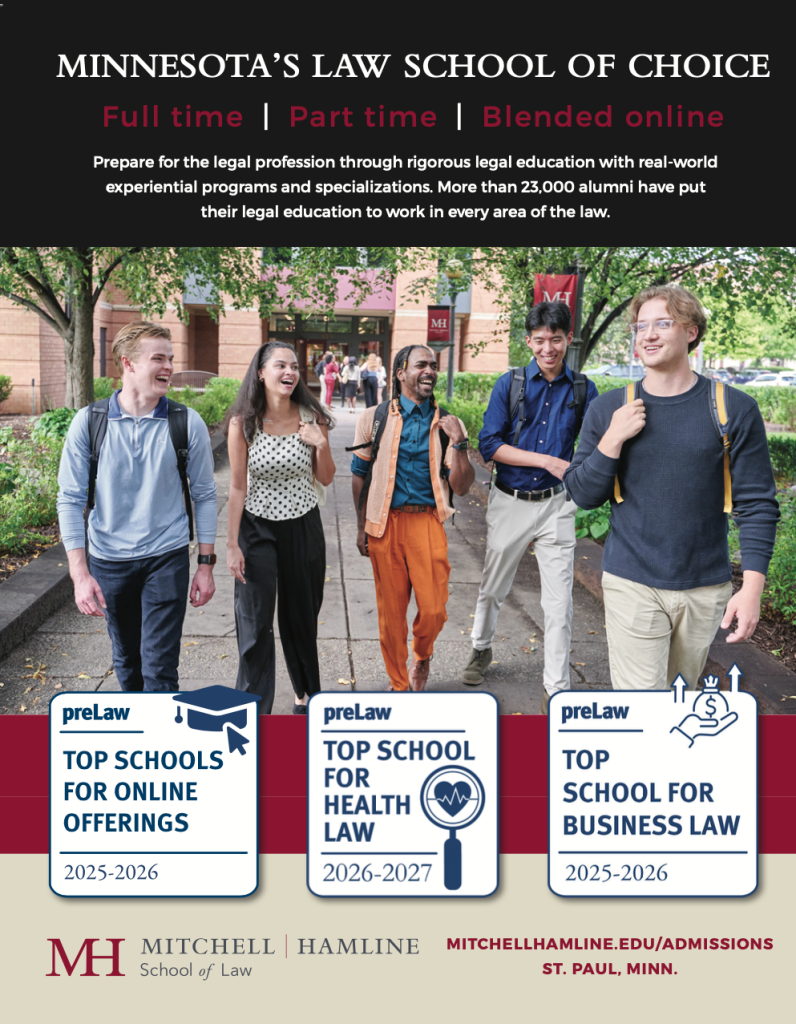
(A+) Mitchell Hamline School of Law
Whether you are a J.D. student or a health care professional, our Health Law Institute gives you a deep understanding and real-life experience through specialized courses, certificates of study, moot court competitions, and experiential learning opportunities.
The institute bridges the gap between health law scholarship and policy through engagement, collaboration, and innovation.
It is a hub for the health law community, providing programs, training, educational opportunities, events, and symposia for law students, attorneys, health care practitioners, and business professionals.
Mitchell Hamline’s Health Law Institute is also ranked by U.S. News & World Report, as Best Grad Schools: Law – Healthcare Law in 2026.
(A+) DePaul University College of Law
Health law students at DePaul University College of Law can get an early start building experience in the field with the extensive programs at The Mary & Michael Jaharis Health Law Institute.
Through its Summer Scholars Job Placement Program, students can receive funding for full-time summer positions with organizations working in health law. The Jaharis Health Law Institute also offers a Health Law Fellows Program, mentorship and networking opportunities. Students gain additional real-world experience through health law externships with hospitals, government agencies, nonprofits and other health care organizations.
A unique opportunity is DePaul’s Health Care Compliance Certification Program which is accredited by the Compliance Certification Board. J.D., MLS and LL.M. students who complete the requirements are eligible to sit for any of the board’s certification exams for up to a year after graduation without additional continuing education or professional work experience.
Students interested in corporate, governmental and regulatory, or public-interest work can pursue an Area of Concentration in Health Law.
Health Law Fellows can connect with practicing attorneys through the institute’s Mentorship Program and receive membership in the Illinois Association of Healthcare Attorneys, giving them additional opportunities to network with health law professionals. Students also can get involved with the DePaul Journal of Health Care Law or contribute to the Jaharis Health Law Blog.
DePaul’s Health Law Transactional Moot Court Team competes in the L. Edward Bryant Jr. National Health Law Transactional Moot Court Competition. Instead of arguing an appellate case, students work through a health care transaction, putting negotiation, drafting and problem-solving skills to work.
(A+) Seton Hall Law School
Seton Hall Law School has provided all the steps needed for students to hit the ground running. At the Health Advocacy and Collaboration Law Clinic, the school’s first medical-legal partnership, students work with the North Jersey Community Research Initiative, a Newark community health organization, on legal issues connected to social determinants of health.
The Center for Health & Pharmaceutical Law connects students with additional career opportunities in health care and the life sciences. Health law externships and fellowships include placements with government agencies, nonprofits and life sciences compliance offices.
J.D. students can pursue a Health Law Concentration focused on traditional health law or life sciences law. A Compliance Track is available for students who want additional training in health care fraud and compliance. Seton Hall also offers an LL.M. in Health Law for attorneys and graduate programs in Health & Hospital Law and Pharmaceutical & Medical Device Law & Compliance.
The Health Law Forum connects students with networking opportunities, internships, externships and jobs and hosts speakers throughout the year. Members also operate Health Law Outlook, a student-run publication where students write about current and emerging health law issues.
Students can compete in the National Health Law Moot Court Competition, researching and writing appellate briefs before arguing health law and policy issues. Seton Hall also participates in national health law competitions focused on transactional and regulatory and compliance work.
(A+) Case Western Reserve University School of Law
Case Western Reserve University School of Law was studying the intersection of law and medicine long before Health Law became the established field it is today. Its Law-Medicine Center, founded in 1953, describes itself as the oldest Health Law program in the country. Today, that work includes some of the most debated legal issues in health care.
The school’s Reproductive Rights Law Initiative focuses on protecting and expanding access to abortion and reproductive health care in Ohio and throughout the Midwest. The initiative provides legal support to abortion providers and advocacy organizations while training future attorneys in reproductive rights law. Case Western says it is the only law school-based program of its kind outside the East and West coasts.
Students can take primary responsibility for cases in the Health Law Clinic, working on legal and social issues that can affect a client’s health. Students may serve as first chair in hearings, trials and negotiations.
J.D. students can pursue a Health Law Concentration, which includes a research paper and experiential capstone. Students also have several health-related dual-degree options, including programs combining the J.D. with bioethics, medicine or public health.
Students interested in writing can join Health Matrix: Journal of Law-Medicine, which publishes student-written articles along with a thematic issue each year. The Student Health Law Association hosts lectures, workshops, symposia and career programs.
(A+) Mississippi Christian University School of Law
Location works in favor of health law students at Mississippi Christian University School of Law. The school sits in downtown Jackson, minutes from Mississippi’s health care corridor, putting students near the medical, legal and policy communities dealing with changes in the health care industry.
The Bioethics and Health Law Center, established in 2009, connects students with members of the medical, legal and policy-making communities to explore the legal and ethical questions facing health care.
J.D. students can earn a Certificate in Health Law that prepares them for areas including compliance, civil litigation and criminal law. The certificate requirements track model curriculum guidance created by the American Health Lawyers Association
Experiential work is required. Students must complete a Health Law field placement through a clinic or externship where they apply Health Law concepts and provide legal advice. They also complete a substantial research and writing project on a Health Law topic.
The Health Law Society works with the Bioethics and Health Law Center to bring local health law attorneys to campus. Speakers have practices ranging from fraud and abuse litigation to hospital acquisitions and regulatory compliance.
(A+) Loyola University Chicago School of Law
Loyola University Chicago School of Law gives health law students opportunities to see how legal problems can affect a person’s health long before they ever reach a hospital.
Through the Health Justice Project, a medical-legal partnership clinic, students work with health care providers and community organizations to address legal and systemic barriers facing low-income patients.
The Beazley Institute for Health Law and Policy oversees Loyola’s Health Law program and connects students with opportunities in health care law and policy. Students also can gain experience through Health Law externships with hospitals, government agencies, associations and other organizations.
J.D. students can earn a Health Law Certificate, which requires practical experience through a clinic, externship or approved Health Law work along with participation in Health Law activities. Students interested in compliance can pursue a separate Certificate in Compliance Studies.
Students interested in writing can join Annals of Health Law and Life Sciences, a student-edited journal focused on developments in health law and policy. Its online companion, Advance Directive, gives students another place to write about current issues in the field.
The Health Law Society brings together students interested in health law through speakers, networking and other programs. Loyola also offers online M.J. and LL.M. programs in Health Law.
This story is sponsored by Mitchell Hamline School of Law.
