

Business lawyers need to understand more than the law. They must also understand how businesses operate, assess risk and make decisions in an increasingly complex marketplace.
Law schools are responding by bringing business strategy and real-world transactions more directly into legal education. Through clinics, corporate partnerships, interdisciplinary programs and courses built around current business challenges, students are learning to advise entrepreneurs, work with companies and understand the legal issues behind business decisions.
The result is a more practical approach to business law education that helps students develop both legal skills and the business perspective they will need to counsel clients.
The following law schools earned a place on our Business Law Honor Roll, recognized for the strength of their programs. Following the list, you’ll find the latest developments and news from business law programs at these various law schools.
Top schools for business law
Lewis & Clark Law School’s Small Business Legal Clinic gives students hands-on experience helping clients protect and develop their businesses. During the 2025-26 academic year, students worked on patent and trademark matters that resulted in two patents and 11 trademarks being issued or registered for clients. Beyond the clinic, Lewis & Clark offers students opportunities with companies including Nike, Intel and ZoomInfo. The school is also adding a one-week shadowing opportunity with financial technology company Chime in the San Francisco Bay Area, giving students a chance to observe the work of in-house counsel and explore corporate legal practice.
Loyola University Chicago School of Law is expanding the boundaries of its business law program by connecting law students directly with entrepreneurs and business students developing new ventures. Through a new collaboration between the Business Law Clinic and Loyola’s Quinlan School of Business, law students presented to entrepreneurship students and offered clinic intake hours to undergraduates seeking legal guidance for startup projects. The clinic also gives students hands-on transactional experience advising nonprofits, small businesses and entrepreneurs on business structures, corporate governance, contracts, tax-exempt status, trademarks and copyrights. Students interested in deepening their transactional training can pursue a Transactional Law Certificate through the Center for Business Law.
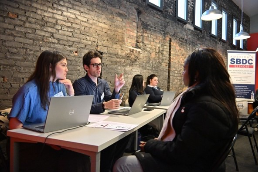
DePaul University College of Law’s Business Law Clinic has doubled its capacity, adding a second section to give more students hands-on transactional experience advising businesses under attorney supervision. The school also launched a Case Study Workshop series that brings practitioners to campus to take students inside recent transactions and examine the legal and business issues involved. Recent workshops led by attorneys from Ropes & Gray, Jones Day and Kirkland & Ellis have covered finance, commercial real estate, technology and intellectual property transactions. This year’s topics include private equity, financial crimes compliance and commercial real estate, with practitioners from companies and firms including JPMorgan, CSC Generation and Jones Day.
St. Mary’s University School of Law is expanding how students learn business law with a new clinic that combines transactional training, entrepreneurship and community economic development. The Microenterprise and Community Development Clinic, the school’s sixth clinic, gives students the opportunity to provide legal assistance to microbusinesses, entrepreneurs and community-based nonprofits while developing practical business law skills. Led by Andrea Beleno Harrington, who joined St. Mary’s from Texas RioGrande Legal Aid, the clinic exposes students to the legal challenges involved in launching and operating small organizations while expanding access to legal services for entrepreneurs and nonprofits that may have limited resources.

Mitchell Hamline School of Law’s Center for Law and Business gives students opportunities to study business law through international programs, partnerships and interdisciplinary education. C-LAB launched the first U.S. law school study abroad program in Kosovo in 2025, where students explored economic development and transitional justice, met with Supreme Court justices and learned about the country’s developing legal system. The partnership has since brought University of Prishtina legal scholars to Mitchell Hamline and returned students to Kosovo for a second summer. C-LAB also offers programming in Germany and Luxembourg focused on international trade, treaties and European Union law. At home, the center supports a joint J.D./MBA with Hamline University that is now available to students in Mitchell Hamline’s blended-learning program.
Northern Kentucky University – Salmon P. Chase College of Law is bringing contemporary business challenges into the classroom through courses that connect legal doctrine with corporate decision making. Antitrust Law introduces students to fundamental principles and emerging issues with an emphasis on how in-house attorneys and lawyers counseling corporate clients encounter antitrust concerns in practice. The Business of IP takes a similarly practical approach to intellectual property, examining how patents and other IP rights influence business plans, operations and competition. Students explore the competing interests of intellectual property holders, competitors and the public while considering the broader economic and policy implications of how companies use intellectual property.
University of California, Berkeley, School of Law’s new Social Enterprise Clinic provides transactional legal services to nonprofit and for-profit organizations that use business solutions to address social and environmental challenges. The clinic gives students hands-on exposure to the intersection of law, business and social impact, while preparing them for careers as transactional attorneys. Students work with clients on matters such as corporate governance, regulatory compliance, contracts and entity formation.
Methodology
preLaw magazine grades law schools based on the breadth of their curricular offerings. Scores are weighted as follows: 30% for a concentration, 24% for a clinic, 12% for a center, 12% for an externship, 9% for a journal, 8% for a student group, 5% for a certificate and added value for additional offerings.
Want to see more rankings? Click here to explore all law school rankings!
