
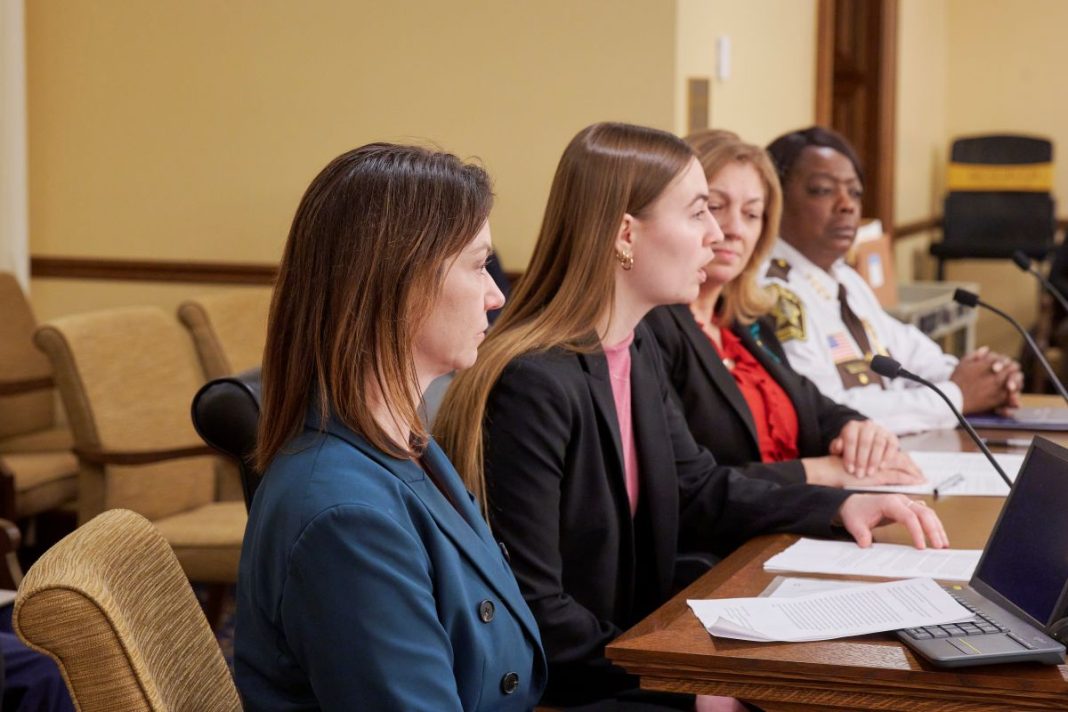
Before stepping into a law school classroom, Maya Budhrani heard the warning: Law school is nothing like being a lawyer.
As a first-generation law student, Budhrani relied heavily on outreach and self-advocacy to navigate the admissions process and prepare for law school.
“I got a lot of information based on cold emails to attorneys,” she said. “I shared that I was applying to law school and wanted to know what to expect.”
For many prelaw students, that disconnect is one of the biggest unknowns when choosing where to apply. Budhrani, now a 2L at University of San Diego School of Law, made it a priority to find a program that would close that gap.

Originally from Dallas, Budhrani attended Texas A&M University for both her undergraduate degree in political science and her master’s in public administration. Her early interests focused on government relations and how different branches of government interact, an interest that continues to shape her legal goals today.
“I was interested in how the legislative and judicial branches work together and how policy and law intertwine,” she said.
That curiosity led her to seek out real-world experience even before law school, including a summer internship with the Texas Education Agency, where she worked on grants and administration. But it was during law school that she began to see how critical hands-on training would be for her future in the legal profession.
When evaluating law schools, Budhrani focused on one key question: Which law school program would best prepare her for legal practice?
“I wanted a law school that was going to bridge the gap between studying to be a lawyer and being a practicing lawyer in the real world,” she said.
At USD School of Law, she found that bridge in the school’s emphasis on experiential learning, particularly through its first-year Experiential Advocacy Practicum.
The program not only introduced her to real legal skills early but also helped her build connections in an unfamiliar place.
The Honor Roll shakeout
To determine our Best Schools for Practical Training Honor Roll, we looked at the number of students each school has participating in clinics, externships, simulation courses, moot court and other special programs. We gave the largest weight to clinics. We asked schools for the number of students who completed a clinic in the prior year. If a student was enrolled in a clinic for two semesters, that counted as two. Extra credit was given to schools that required clinic work.
After crunching the data, Northeastern University School of Law takes the top spot again on this year’s Honor Roll. University of Minnesota Law School moved up two spots to No. 4, and USD School of Law made the biggest jump from A- to A+, landing in the Top 10.
There are 12 law schools that are new to the Honor Roll this year: University of Florida Levin College of Law, University of Illinois College of Law, Gonzaga University School of Law, The University of Alabama School of Law, The University of Tulsa College of Law, Florida International University College of Law, Santa Clara University School of Law, The Ohio State University Moritz College of Law, University of Utah S.J. Quinney College of Law, University of Maine School of Law, University of Texas School of Law and Yale Law School.
Law schools that moved from B+ last year to A this year on the Honor Roll are Washington and Lee University School of Law, University of Maryland Francis King Carey School of Law and Lewis & Clark Law School.
To view the full ranking of the 2026 Best Law Schools for Practical Training, click here.
From theory to practice
Legal education has long been rooted in doctrine. Students learn to analyze cases, interpret statutes and engage in rigorous legal reasoning. These skills remain foundational. But they are no longer sufficient on their own.

Mitch Zamoff, assistant dean of experiential education at Minnesota Law, has spent years thinking about that gap between knowledge and application.
“Knowing the law in and of itself is important, but unless you know how to use it, you’re going to be an average to below average lawyer,” Zamoff said.
That simple statement captures a growing consensus across legal education. Employers want graduates who can contribute immediately. Clients expect lawyers who can navigate real problems, not just theoretical ones.
Experiential education addresses this important need.
“I would argue that the translation from theory to action is the core of professional competence,” Zamoff said.
This translation is what transforms a student into a professional. It is also what many law schools historically left to the first years of practice, when new attorneys were expected to learn on the job.
“That’s a difficult way to learn,” Zamoff said. “We should be doing more of that translation during the law school years.”
And increasingly, schools are.
Building lawyers from week one
At USD School of Law, students do not wait long to experience what legal practice looks like.

Under the leadership of Linda Lane, professor at USD School of Law, the Experiential Advocacy Practicum introduces first-year students to the mechanics of lawyering almost immediately.
From the first weeks of law school, students are not just reading about litigation. They are doing it.
“They’re learning the life of a case,” Lane said, drawing on her own background as a litigator. “It’s meant to feel real.”
In the fall semester, students work through a simulated negligence case. They conduct client interviews, take depositions and ultimately deliver closing arguments from their semester long position as either plaintiff’s counsel or defense counsel. These are not abstract exercises. They are structured, guided experiences that mirror real legal work.
What makes the program especially distinctive is its structure. Students move from large lectures into small groups led by practicing attorneys, including prosecutors, public defenders and private practitioners. This allows them to learn the mechanics of law and the realities of different career paths in the law.
By the fifth week of law school, students are already taking depositions. For many, that is a moment of clarity.
In the spring, the focus shifts to transactional law. Students negotiate deals, draft documents and work through a simulated business transaction.
“They’re getting exposure to both sides of the profession,” Lane said. “Litigation and transactional work.”
For students like Budhrani, that exposure is invaluable. She currently works as a legal intern with Singleton Schreiber, a personal injury law firm in San Diego. She credits her practical training at USD School of Law with helping her succeed in that role and building confidence and skill sets for professional growth.
“I don’t think that I would be as strong of a candidate or as productive if I didn’t have practical experience,” she said.
Because of her early exposure to hands-on legal work, Budhrani found that she was able to adjust more quickly in a professional setting.
“There was less of a learning curve, and I knew what questions I was supposed to be asking and what to expect,” she said. “It helped me get my footing a lot faster.”
Expanding experiential learning
At Minnesota Law, experiential education is not confined to a single course or program. It is embedded across the curriculum.
Zamoff describes a philosophy that extends beyond clinics and simulations.
“We try to think about experiential learning more broadly,” he said. “Every time we create an observational opportunity or a skills module, we’re activating a different part of the student’s brain.”
This approach reflects a shift in how legal education is structured. Rather than separating doctrinal and experiential learning, Minnesota Law is working to integrate the two components.
“Students might draft a client email in a civil procedure course or engage in a negotiation exercise in a contracts class,” Zamoff said. “These moments reinforce the connection between theory and practice.”
Minnesota Law has also increased its experiential credit requirement beyond accreditation requirements, requiring students to complete more hands-on training before graduation, increasing the requirement from six to nine.
Dean William McGeveran sees this change as essential.
“Thinking like a lawyer is only half of the learning that you need to do,” he said. “You can have theoretical knowledge but not know how to put it into practice when you graduate.”
That philosophy is reflected in the school’s signature “Law in Practice” course, where first-year students engage in simulation-based exercises with trained actors playing clients and witnesses.
“You’re not interviewing a classmate who’s reading a script,” Dean McGeveran said. “You’re interacting with someone who can respond in a realistic way and give you constructive feedback.”
Students develop a theory of the case, test it through interviews and revise their approach based on new information. It is a process that mirrors real legal work.
Judgment, ethics and emotional intelligence
One of the most important benefits of experiential learning is the development of judgment.
“When you’re placed in real practice scenarios, you’re dealing with uncertainty,” Zamoff said. “You have to prioritize facts, assess risks and navigate complex interpersonal dynamics.”
These skills cannot be fully taught through lectures. They require experience.
Ethical awareness is another key component. While students learn professional responsibility rules in the classroom, applying those rules in real situations is far more intense and convoluted.
Minnesota Law has introduced simulation-based ethics training to address this gap and move students forward.
“It’s one thing to learn the rules,” Zamoff said. “It’s another thing to apply them in a real scenario.”
Communication skills also play a central role. Lawyers must write clearly, argue persuasively and connect with clients.
“Experiential training builds emotional intelligence,” Zamoff said. “It helps students become trusted advisors.”
Inside Elon Law’s immersive model
At Elon University School of Law, experiential learning is the foundation of its curriculum.
Dean Zak Kramer describes a program designed around legal practice from the ground up.
“You cannot graduate from Elon Law without knowing exactly what it’s like to be a lawyer,” Dean Kramer said.
The experience begins the moment students walk into the building, where a working courtroom serves as a constant reminder of the profession they are entering.
The curriculum includes an intensive August term that introduces students to legal study and practice before the traditional academic year begins.
Patricia Perkins, associate dean of academic affairs at Elon Law, emphasizes the importance of this early foundation.
“Our curriculum is designed to assist students in transforming into the lawyers they want to be,” Perkins said.
Students engage in simulations, writing exercises and oral arguments from the start. They also begin developing their professional identity, reflecting on what it means to serve various clients and contribute to the legal system.
“Skills are just as important to develop as a knowledge base,” Perkins said.
Learning by doing
Elon Law’s approach extends throughout the curriculum, culminating in its signature residency program.
During a 10-week placement, students work full time in legal settings, taking on real responsibilities under supervision.
“The legal practice becomes their classroom,” Dean Kramer said. “They leave law students and come back lawyers.”
Perkins sees this as transformative.
“You just can’t be more practical than that,” she said. “It gives students a chance to see the day-to-day reality of being a lawyer.”
These experiences also reinforce the service-oriented nature of the profession.
“Being in the service of others is the legal profession at its best,” Perkins said.
Finding direction through experience
For many law students, the “aha” moment doesn’t come from reading cases. It comes from doing the work.

For Jack Thomas, a 3L at Minnesota Law, that moment arrived when he stepped into a simulated legal exercise and finally saw how everything fit together.
“After my first semester, I thought, this is really academic,” Thomas said. “But when we started doing that practical class, I was like, oh, this is what it’s all about. This is really where the rubber truly hits the road in law school.”
Thomas did not start out on a traditional prelaw path. He studied civil engineering at Purdue University, but something never quite clicked.
“I was trying to do all the technical stuff, which I enjoyed,” he said. “But at the end of the day, the work just wasn’t my thing.”
It was a senior design presentation that changed everything.
“Right after the presentation, my professor pointed at me and said, ‘You were born to present and defend designs,’” Thomas said. “That’s when I thought about pursuing law and being a lawyer.”
Like many future law students, Thomas entered the process with limited exposure to the profession.
“I came in blind,” he said. “I didn’t really know what law was about at all.”
That uncertainty followed him into law school. After his first semester, Thomas still felt disconnected from what it meant to be a lawyer.
Then came Minnesota Law’s simulation-based “Law in Practice” course.
“It’s a low-stakes but high-stress first jab at conducting client interviews, taking depositions and participating in mediations,” Thomas said.
For him, it was transformative.
“This is why we’re learning this stuff,” he said. “This is how I want to use it.”
Thomas entered law school assuming he would enjoy litigation and was surprised he also enjoyed transactional work.
“Having practical training challenges your assumptions about the kind of lawyer you want to be,” he said.
That discovery process is important given how early legal recruiting now begins.
“Students are locking themselves into career paths very early,” Thomas said. “Without early practical training, you might not have any interest in the path you choose in law school.”
By the time he secured a position with Foley & Lardner LLP in Milwaukee, Wisconsin, Thomas had a clear direction. He plans to practice intellectual property litigation, combining his technical background with his interest in advocacy.
The most important lesson Thomas has learned is not about legal doctrine or courtroom strategy. It is about mindset.
“Don’t let perfect be the enemy of the good,” he said.
In a field known for high expectations that advice carries weight.
“The pressure is to be perfect,” Thomas said. “But you can’t let that stop you from getting started.”
Practical training creates a space where students can make mistakes, learn from them and improve skill sets.
“If you get the opportunity to make a mistake in law school before your career even starts, it’s ideal,” he said.
For students considering law school, Thomas offers a simple but powerful approach.
“Think about your strengths and why you want to be a lawyer,” he said. “Then lean into those strengths when you get into practical training.”
Thomas also encourages future law students to stay open to discovery and growth.
“Don’t let fear stop you from being the lawyer you are meant to be,” he said.
