

Santa Clara University School of Law has received a $5 million gift to fund the High Tech Law Institute. The mission of the institute is to educate and prepare students to lead at the intersection of law, technology, business and society.
It will be renamed the Datta Center for High Tech Law thanks to the gift from Madhumita “Mita” Datta, a 2016 J.D. graduate, in honor of her late parents Madhuri Datta and Sunil Datta.
The Datta Center for High Tech Law is one of three specialty-focused centers of excellence at the law school, including the Center for Global Law and Policy and Center for Social Justice and Public Service.
“Dr. Datta’s extraordinarily generous $5 million contribution will not only empower our faculty and students to shape the ever-evolving technology landscape, it will inspire generations of legal professionals to follow the Datta family’s example of using their education and emerging technologies to design human-centered approaches to solving the world’s most urgent problems for the greater good,” said Michael Kaufman, dean of Santa Clara Law.
Since the institute’s founding in 1998, it has offered a variety of programs covering privacy, entrepreneurship, business, intellectual property, sports law and more, while connecting students to a powerhouse network of legal professionals.
The Institute has also seen a rise in future lawyers who studied STEM and, like Datta, see the value of science and engineering knowledge for fostering and protecting innovation and creativity. In 2025, 20% of incoming Santa Clara Law students studied STEM as undergraduates.
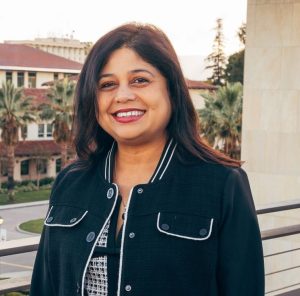
Just under a decade ago, Datta herself was one of the students making that transition from engineering to law. After earning her Ph.D. in electrical engineering from the University of Maryland, College Park, during which she obtained her very own patent, Datta became a patent agent, practicing for eight years at various law firms before starting her law school journey. She was drawn by the opportunity to learn about exciting, cutting-edge technology through a different lens and to help others, including under-resourced solo inventors, legally protect their ideas.
“Every profession is powered by what is in the backend and the backend is essentially high tech,” Datta said. For example, a transcription tool used by a doctor, a risk assessment tool used by a social worker, a strength training algorithm used by an athlete, a sound mixer used by a musician — I can go on and on. We should think of high tech law as not only applicable to creating semiconductor chips or computer programs, but also in terms of what those high tech products are enabling.”
