
For students, one question towers above almost every other consideration when choosing a law school: Will I have a job when I graduate?
The answer increasingly depends on more than rankings or reputation. It depends on whether a law school begins preparing students for the legal marketplace on day one, whether it builds meaningful employer relationships, whether it teaches students how to navigate a changing profession and whether it creates opportunities for practical experience before graduation arrives.
To gauge law school employment outcomes, we looked at the American Bar Association data comparing the difference between two time periods, Classes of 2012-2014 and the Classes of 2023-2025. We used three-year averages of a modified employment rate to track the quality of jobs obtained by graduates.
Our analysis found that legal employment moved beyond recovery in 2021 into a more stable phase in 2025, signaling the current market strength is structural, not temporary.
Law schools capitalizing on the gains in the market, those with marked improvement in post-grad employment rates, had the most room to grow. Many of the law schools have now moved into the 80% to 90% range or higher, shifting from turnaround stories to consistent performers.
Schools that were 60% to 75% in the early period and are now 80% to 90% include Northeastern University School of Law, University of Oregon School of Law, Drexel University Thomas R. Kline School of Law, Villanova University Charles Widger School of Law and LMU Loyola Law School.
University of California, Irvine School of Law was a success story in employment improvement. This young law school built a top-tier employment engine in just over a decade, moving from 54.3% to 94.3% — 73.8% growth.
Texas A&M University School of Law improved with major investment, a branding shift and an aggressive career strategy to climb the ranks with 51.9% growth.
To view the full ranking of the 2026 Most Improved Law Schools for Employment, click here.
Law schools that posted significant gains in graduate employment emphasized analytics and intervention, building professional identity, alumni engagement and experiential learning. Although the law schools had varied approaches, their methods yielded results.
Here are five law schools in our ranking and how their approach to employment after graduation is prepping the legal career launch.
Practice-ready grads
Austen Parrish, dean of UC Irvine Law, believes employment success starts with understanding students as individuals rather than numbers.
That philosophy begins immediately. During orientation, every student is assigned a career counselor who often remains with them throughout all three years of law school. The goal is not simply to answer questions or review resumes. The goal is to know each student’s interests, strengths, ambitions and evolving career goals.
“We have a philosophy of individualized career counseling,” Parrish said.
Students receive one-on-one resume reviews, mock interviews and market-specific guidance. Career counselors specialize in different sectors of the legal profession, including large law firms, judicial clerkships, public interest organizations, government positions and nontraditional careers.
Parrish believes that specialization matters for career success.
The school’s Career Development Office includes professionals with experience as practicing attorneys who understand the realities of their respective markets and maintain close relationships with employers.
Equally important is the office’s philosophy on student engagement.
“It’s not about doing the work for students but ensuring students take ownership of their job search,” Parrish said.
The school also moved career development earlier in the student experience than many law schools historically have.
The school’s required first-semester first-year Legal Profession course introduces students to legal careers, law firm structures and the realities of practice through panels and discussions with practicing attorneys.
Students begin building professional identities while many peers elsewhere are still learning legal vocabulary.
Experiential education sits at the center of the school’s strategy.
“We believe experiential learning is critical for students,” Parrish said.
Students begin working with real clients through the pro bono program during their first weeks of law school. They participate in mandatory clinics and develop practical skills through a Lawyering Skills program that places them in direct contact with clients during their first semester.
Those experiences produce the graduates that employers recognize as immediately useful.
“We’re giving law firms, nonprofits, public interest organizations and government agencies what they want — students with practical training on lawyer tasks that can hit the ground running,” Parrish said.
That reputation compounds over time.
“Once law firms and nonprofits have hired our students, our students have done well, and they have wanted to hire more,” Parrish said.
Parrish also pointed to student quality and culture as important contributors. Often about 30% of the class are first-generation college graduates and another 30% come from lower-income backgrounds.
The school intentionally looks for grit, resilience and growth mindsets during admissions.
The result, Parrish said, is a student body eager to work and eager to prove itself.
Combined with strong alumni support in markets ranging from New York to Seattle, the formula has created an increasingly powerful employment pipeline for graduates of UC Irvine Law.
Momentum continues
Robert Ahdieh, dean of Texas A&M Law, described his school’s employment story as the product of institutional momentum.
“Great students, great faculty, great staff,” Ahdieh said.
The law school recruits students for both “caliber and character” while simultaneously investing heavily in faculty recruitment and professional staff. And career development operates at an unusually intensive level, with an aggressive employment philosophy.
“You will have a job whether you want one or not,” Ahdieh said.
Career professionals spend enormous amounts of time helping students prepare for interviews, identify opportunities and build relationships with employers throughout the region and beyond.
The office also advocates directly for individual students.
Staff members meet with employers and discuss not only the strengths of Texas A&M students generally but the strengths of particular students and the value they can bring to organizations.
Professional identity is another pillar of the school’s strategy.

Long before accreditation standards emphasized professional identity formation, Texas A&M Law required a first-year course helping students understand who they are, what they value and where they hope to go professionally.
“It’s not, ‘I got a job.’ It’s, ‘I found the job that’s the right fit for me,’” Ahdieh said. “Experiential learning reinforces that effort.”
Clinical opportunities, pro bono requirements, interview coaching and practical experiences expose students to the realities of legal practice while in school.
Then there is geography. The Dallas-Fort Worth legal market has exploded alongside the region’s population growth.
“Take anything that you’d find in any city and double it,” Ahdieh said.
Courts, corporations, firms, agencies and legal departments create opportunities across nearly every imaginable practice area. Alumni support amplifies the opportunities.
Ahdieh said that Texas A&M graduates have watched their degrees rise in prestige and visibility during their careers, creating an unusually enthusiastic alumni network eager to support current students.
“Everyone graduates from a higher ranked school than the one they started at,” he said. “That pride has become an employment engine in its own right.”
Early intervention
Jerry Dickinson, dean of Pittsburgh School of Law, described the school’s growth as the evolution of a respected regional institution into a national legal player.
“We have grown into much more than just a regional powerhouse,” Dickinson said.
The school’s strategy centers on what Dickinson called “a wholesale integration of student-centered programming and student-centered focus.”
Career development is not isolated in one office. It stretches across the institution.
One of Pitt Law’s most innovative initiatives involves data.
The Professional Development Office tracks student engagement, including event participation, networking activities, employer interactions and office visits. When students disengage, the school reaches out.

The philosophy is straightforward. Without intervention, some students inevitably fall through the cracks. Pitt Law built systems specifically designed to prevent that outcome.
The Pitt Law Academy introduces first-year students to resumes, interviews, networking and the mechanics of the legal job market. Many students arrive viewing law school as a temporary pause before professional life begins.
Dickinson said that some students think, “I came here to postpone the real world for three years.”
The academy changes that mindset.
“Their legal professional career starts on day one in law school,” Dickinson said.
The school has also made substantial investments in experiential education, including creating a dedicated Office of Experiential Learning and appointing leadership specifically responsible for practical training opportunities. Externships have become particularly important. Students work in courts, firms, corporations and government offices while still enrolled. Employers become familiar with students long before hiring decisions are made. In many cases, those experiences evolve naturally into permanent employment opportunities.
The school’s alumni network reinforces those efforts.
Dickinson recalled a reception in Harrisburg where a first-year student met a judge during an alumni event and left with an internship opportunity.
“There is that residual ripple effect on employment and growth,” Dickinson said.
Career development
Geoffrey Rapp, dean of DePaul University College of Law, believes how law schools prepare students for legal careers has fundamentally changed.
The old employment model, he said, no longer works.
“The old approach of leaving it in the hands of law firms that might want to recruit people doesn’t work,” Rapp said.
Neither does waiting until the second year of law school to think about careers.
“The old approach of leaving it to your second year of law school doesn’t work. That’s too late,” he said.
The response was a required first-year professional development course called Preparing to Practice, or P2P.

The program introduces students to legal practice areas, professional identity, networking and job search strategy while they are adjusting to first semester classes.
The DePaul Law also reimagined its career office, changing the office’s name from career services to professional and career development to reflect a broader mission.
“It’s not enough to be a job posting board and a scheduler of interviews,” Rapp said. “The reality is that most law students do not obtain jobs through on-campus interviewing programs. Most jobs come through relationships, networking and initiative.”
DePaul Law’s response has been to teach those skills intentionally and its alumni network also provides a major advantage. More than 10,000 alumni work throughout the Chicago region. Small-group alumni lunches and weekly career tables outside of the student lounge bring students together with practicing lawyers in fields they hope to enter.
“It helps demystify what it’s like to practice in that area,” Rapp said.
The school also uses employment reporting as an opportunity to reconnect graduates with opportunities rather than simply satisfy accreditation requirements.
“It’s an excellent opportunity to help the graduate rather than just a compliance task,” Rapp said.
Class size reductions have also increased access to personalized support and professional opportunities.
“That alumni lunch for eight people only matters if you can get a seat at the table,” Rapp said.
Location provides another advantage. Chicago itself functions as a classroom and professional laboratory. Patent law, privacy work, public defense, corporate practice, public interest organizations, government agencies, judicial opportunities and more all exist within reach of campus.
“The city is an extended classroom,” Rapp said.
Careers have many chapters
Jennifer Reynolds, dean of Oregon Law, approached employment growth from a different angle, challenging the idea that legal careers follow predictable paths.
“We don’t want students to think of career paths as linear,” Reynolds said.
Instead, she encourages students to think of their careers as evolving stories.
“We really encourage them to think of it as a book of many chapters,” she said.
That philosophy shapes the entire student experience.
Reynolds, who has been with Oregon since 2009, watched the school’s career center evolve from a place students feared into a place students actively seek out.
“We were all kind of afraid of going to the career center,” she said of her own law school experience.
At Oregon Law, the goal became creating an environment students view as welcoming, supportive and accessible.
The school’s required Foundations for Professional Success course introduces career planning in the first semester.
Small cohorts work with faculty, student affairs professionals and career counselors. The curriculum blends professional identity with practical skills. Students explore questions about values, goals and purpose while simultaneously learning resumes, networking, informational interviewing and mentorship development.
Reynolds described the course as combining introspection with essential practical preparation.
“The school also hosts regular gatherings that encourage students to become comfortable seeking help and building relationships,” she said. “One popular series, Cookies and Coffee with the Career Center, creates informal opportunities for students to meet lawyers, judges and career staff.”
Reynolds said the objective of these gatherings is not only employment, but also comfort, confidence and engagement.
Every professional experience contributes to a student’s long-term growth, even if it falls outside initial ambitions, she said.
“Every work experience is valuable, and students are encouraged to see unexpected opportunities as steppingstones rather than detours,” she said. “A construction law position may become a lesson in negotiation, contracts or labor relations.”
Reynolds said the dream job is something you work toward and that message becomes particularly important when students meet successful alumni. Students may admire a lawyer working at Nike in sports law, but Reynolds reminds them that careers are built incrementally.
“The lawyer for Nike did not start out as a lawyer for Nike,” she said. “For students entering a profession filled with possibilities, that perspective can be empowering. It replaces anxiety with curiosity; it replaces fear of making the wrong choice with confidence that legal careers have room to evolve.”
The walk across the stage
Employment statistics tell one story. Commencement tells another.
For students contemplating the years ahead, graduation can feel impossibly far away. There are LSAT scores to earn, applications to submit, casebooks to survive, outlines to finish and eventually a bar exam waiting at the other end. Yet the day arrives. The years pass faster than students expect. And suddenly they are walking across a stage, shaking hands and stepping into the profession they once only imagined joining.The scenes look different from campus to campus. The emotions do not. It’s a pivotal moment marked with excitement.
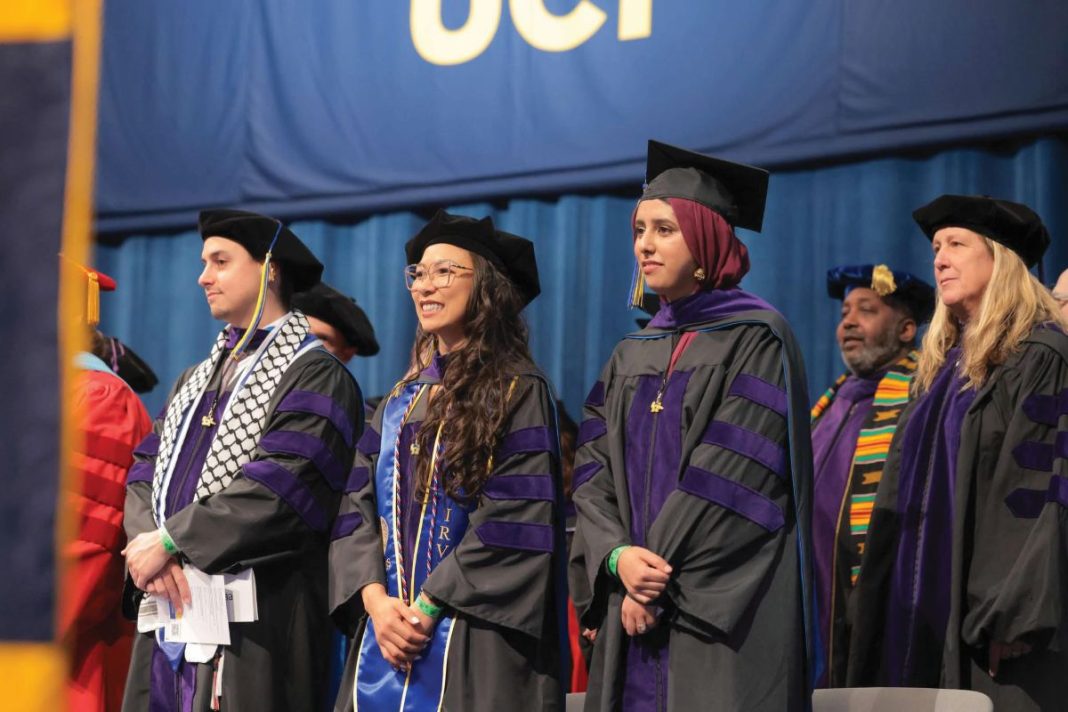
Dean Parrish described commencement at UC Irvine Law as something closer to a family celebration than a formal ceremony. The law school holds graduation in a large arena that allows students to bring grandparents, siblings, cousins, children and entire support systems to witness the moment.
That matters at a school where large numbers of students are first-generation college graduates and first-generation professionals. The audience reflects the diversity of Southern California itself.
Families arrive carrying flowers and leis. Some celebrate cultural traditions unique to their communities. Others arrive with handmade signs and cameras already recording. Occasionally there are mariachi bands waiting outside the venue. Sometimes graduates cross the stage carrying young children in their arms.
Parrish described seeing immense pride radiating from the crowd.
“There is a lot of beaming pride from the audience,” he said. “For many families, graduation marks far more than a degree; it marks an entirely new chapter in the history of the family itself.”
Graduation at Pitt Law unfolds inside one of the most distinctive venues in legal education: Soldiers and Sailors Memorial Hall and Museum.
The setting feels almost purpose-built for lawyers entering public life. Graduates climb grand staircases beneath memorial architecture dedicated to service, sacrifice and civic responsibility. Military artifacts surround the ceremony and cannons stand nearby. Inscriptions honoring liberty and democracy line the building.

Dean Dickinson said the ceremony intentionally centers students rather than the institution with faculty members joining the graduates on stage. Alumni return to speak to the next generation. Families fill the hall.
One of Dickinson’s favorite moments of graduation comes when he describes the experiential work students completed during law school. Parents who may have only heard vague descriptions of classes suddenly learn their children worked alongside physicians serving unhoused communities, studied legal systems inside prisons or participated in Supreme Court advocacy programs.
“Much of law school is abstract to parents and grandparents,” Dickinson said. “Commencement makes it real and the message graduates hear that day is simple: You are ready.”
Few law school graduations possess quite the cinematic quality of DePaul Law’s ceremony with commencement taking place at the historic Chicago Theatre beneath one of the most recognizable marquees in America.
Dean Geoffrey Rapp described professors preparing backstage in dressing rooms once occupied by generations of Broadway performers.
The walls still carry signatures from actors and productions that passed through the theater over decades. Then the faculty takes the stage. A member of the faculty stands at center stage holding the university mace. Students proceed down the aisles toward their seats. The curtain rises.
For a few moments, law school feels less like graduation and more like opening night. After the ceremony, graduates spill onto sidewalks and streets beneath the glowing marquee to take photographs with friends and family. For many students, especially first-generation graduates, the emotions are overwhelming.
Rapp said that recognition of first-generation graduates during commencement generated “a strong outpouring of positive emotions from the audience.” Members of the school’s first-generation student organization wear special stoles marking the journeys that brought them to that moment.
At Texas A&M Law, commencement brings closure to three years of building the foundation to launch a legal career.
“What always strikes me most is the excitement with which our graduates greet the faculty and staff after the program concludes, smiling, laughing and thanking them for their support, and getting too many pictures to count,” Dean Ahdieh said. “That always strikes me as the best proof of the community we’ve built!”
At Oregon Law, the celebration begins before graduation day arrives.
Two days before commencement, students gather at the law school for a pre-graduation celebration with family members, faculty and staff. Pictures are taken. Stories are shared. Students introduce professors to parents and grandparents who have heard about them for years.
Dean Reynolds described it as one final gathering before everyone begins moving in different directions.
Graduation itself takes place at Matthew Knight Arena. Families fill the seats surrounding the arena floor while graduates sit at center court. Cheering is encouraged.
Every graduate receives their own eruption of applause. Families shout names. Friends celebrate loudly. The room becomes less ceremony and more celebration.
Reynolds called it “the most joyful time.”
The commencement speeches by students and Oregon Law’s keynote are inspiring. Afterward, graduates linger for pictures before heading to dinners with family and friends. The Oregon Duck often makes an appearance for photographs.
“And then comes the reminder every law graduate knows all too well,” Reynolds said. “Bar prep starts Monday.”
