
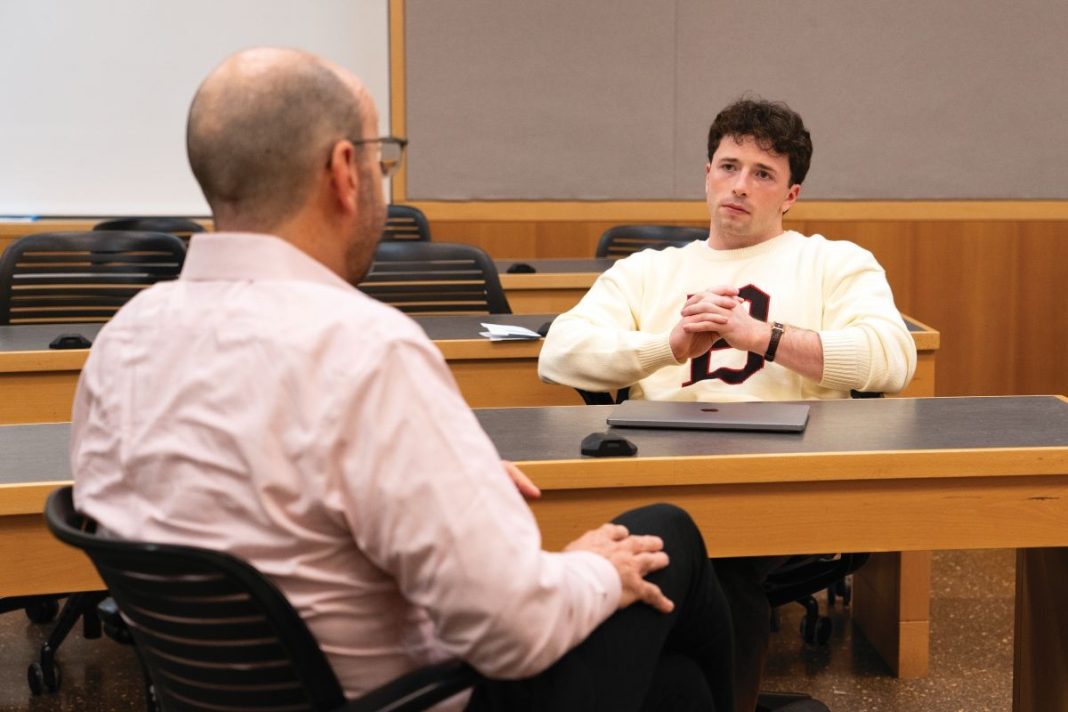
Acclimating to law school can be tough, as students seek to balance the intense workload and adjust to the Socratic learning method versus the memorization skills they may have relied on as undergraduates.
But now those hoping to land a position in BigLaw have yet another stressor — the ever-accelerating application process for those coveted rising 3L summer associate positions.
While recruiters have been slowly moving up deadlines due to the increased competition to land top talent, the online interviews that replaced traditional on-campus programs during the pandemic sped up the timeline even further, with some employers opening their application portals as early as October in 2025.
Others are combining rising 2L and 3L summer associate offers and giving students — the majority of whom are still trying to get a handle on the different practice areas, career paths and the BigLaw landscape — little time to make the potentially life-altering decisions.
Historically, BigLaw firms would start the summer associate recruiting process after students completed their first year of law school, and possibly their summer internships, said Anna DiSalvo Konschak, director of career strategy and professional development at Temple University – James E. Beasley School of Law in Philadelphia.
“Now students are being asked to absorb their coursework, study for exams, research firms, understand practice areas, build networking relationships and prepare exemplary application materials at the same time,” Konschak said. “They are also faced with the often-confusing web of both 1L and 2L summer programs, jumbo offers, public interest stipends and what it all will mean for their postgraduate career.”
She said this year they saw 1Ls stressing about 1L and 2L summer associate applications before taking a fall semester exam.
Temple Law 1L Ari Shalit is among those who went through the new process.
“I knew BigLaw recruited early, but I didn’t know the recruitment included summer positions for summer 2026 and summer 2027,” Shalit said. “I was applying for a summer job a year and a half in advance with the potential of securing a 2027 summer job before a summer 2026 job.”
Shalit said the early recruitment added another layer of stress.
“I had to start doing my research to find out what was available and who was recruiting,” he said. “I had to get my name out there even before I took my first semester finals.”
He said upper-level students could only provide minimal guidance because they didn’t have the same timeline.
“The career services office was helpful, but it was still hard to apply to law firms without really knowing what I want to do and not having a full understanding of all the opportunities available,” Shalit said.
The New Jersey native wants to remain in the area, so he limited his search to his home state and Delaware and Philadelphia.
Shalit started interviewing right after taking his finals and is waiting to hear back from several firms. He also has a few other interviews scheduled.
He did get a law clerk position for the summer of 2026 at a mid- to BigLaw-sized firm in Philadelphia.
While he does wish the application process hadn’t started so early, he also sees some positives.
“Though it’s been stressful, I definitely learned how to juggle different tasks at the same time,” Shalit said. “This truly puts a student in a position to not only learn how to seriously time manage but also deal with stress when the future is unpredictable, which is a valuable skill for aspiring attorneys.”
How schools are responding
Over at University of California, Berkeley, School of Law, Eric Stern, assistant dean of career development, said the Career Development Office (CDO) unveiled a robust series of new first semester employer engagement events and re-envisioned its organized interview programs.
“We typically present a series of foundational programs over the course of the entire first year of law school to introduce 1Ls to the legal profession and teach them the skills they will need to engage with attorneys and then to research, apply and interview for different job opportunities,” he said.
Stern added due to the new, accelerated BigLaw hiring timelines, the law school felt compelled to move its foundational 1L programs into the school’s first semester.
“While the accelerated BigLaw hiring timeline was the lever that pushed our 1L programming into the fall semester, we found that our 1L foundational curriculum benefited all 1Ls, no matter what kind of job they were pursuing,” he said.
The school also moved its large, annual BigLaw virtual interview program to January.
“Students submitted applications to participating firms and the firms decided who they wanted to interview, via our virtual platform,” Stern said.
The CDO also worked closely with faculty to create a new one-credit course titled Introduction to Big Law Practice for 1Ls, which was offered for the first time in January 2026.
Taught by Professor Frank Partnoy, it covers topics ranging from the economics and structure of BigLaw firms to the differences among practice areas.
“We had 18 students, with about half interested in transactional law and the other half in litigation,” Partnoy said.
One of the first things Partnoy asked students in the class to do was create a business plan that included the remainder of their time in law school and where they saw themselves down the road.
“The new timeline is exponentially more stressful for students, and my goal was to show them there was a path to accomplish their goals,” he said. “While many started the course with a high level of stress, they completed it with a lower level of stress with a specific plan in place.”
Other new programs from the CDO at Berkeley Law include a coffee chat series, which took place on Thursday mornings for 11 weeks during the fall semester. The open house-style drop-in format allows 1Ls to have one-on-one conversations with four to five different employers ranging from law firms and nonprofits to government agencies, judges and judicial staff.
“With employers hiring on different timelines, our approach this year was to offer multiple ways, i.e., interview programs, resume books, posting to our online jobs database, for employers to interview and hire our students,” Stern said.
Dylan Maloney, a 1L at Berkeley Law, completed the new BigLaw course, along with taking advantage of the coffee chat sessions and other organized events hosted by the firms themselves.
“The course was very valuable,” he said. “It brought a group of people going through this crazy process together, which allowed us to share our different experiences.”
Maloney said creating the business plan really helped him to organize and evaluate his goals.
“It has become my elevator pitch for where I want to be in a few years,” he said.
In his case, he entered law school knowing he wanted to be a litigator in the media, entertainment and music space, with no BigLaw firm requirement.
As a result, he said his biggest source of stress was the pressure he felt to apply to BigLaw as many of his peers were doing.
“There is a feeling like you might be missing out on an important opportunity,” Maloney said.
Maloney decided to stay his original course, focusing his networking efforts primarily on the mid-size law firm Pryor Cashman in New York, where he secured a position for the summer of 2027.
“Honestly I think the most important factor when applying is to communicate your enthusiasm to the employer,” he said.
