

Averee Richardson wanted to go to law school, but living in rural Ohio and working full time made a traditional program nearly impossible.
She graduated in January from University of Dayton School of Law’s Hybrid J.D. program, an option that allowed her to complete most coursework online while continuing her career.
For many students, hybrid and online law programs make the difference between attending law school and never pursuing the degree at all.
“I was a first-time home buyer in a rural area,” Richardson said. “I was also, and I still am, a full-time working professional. I am the breadwinner for my family. So I knew that taking three years off from working to pursue law school wasn’t necessarily feasible.”
Dayton’s hybrid program allowed her to complete most coursework online while traveling to campus once each academic year for a three-day residency.
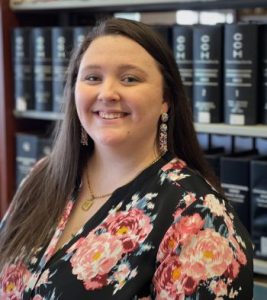
Before law school, Richardson worked as a courts and crime journalist, a business journalist and eventually a newspaper editor. Covering the justice system sparked her interest in pursuing a legal career.
When researching law schools, Richardson said she focused on programs that would allow her to continue working while still offering the same opportunities as residential students.
“I knew I wanted journal experience,” she said. “I knew I wanted public speaking experience. I knew I wanted networking because the people you graduate with are the people that you practice with.”
She found those opportunities at UDSL, where she became deeply involved in campus life despite studying remotely. Richardson served on law review, competed in moot court and held leadership roles in several student organizations.
The experience challenged her expectations about online legal education.
“I went into this experience expecting to be treated differently,” Richardson said. “But what ended up happening is thanks to technology, we were in constant contact all of the time.”
Now awaiting results from the February bar exam, Richardson has already begun working as a judicial clerk for a federal judge.
Looking back, she encourages prospective students to explore the growing number of pathways into the legal profession.
“If it’s in your heart and it’s in your mind, it’s always worth a try,” she said.
Richardson is part of a growing number of students pursuing law degrees through online and hybrid programs — an option that has expanded rapidly across U.S. law schools in recent years.
Leaders in Online J.D. Offerings
Scroll horizontally to see all columns. Click on a column with an arrow to sort by that column and click again to sort in reverse. You may also search the table, page through the results, and set how many items to show at a time.
How Online J.D. programs work
Online J.D. programs have expanded quickly in recent years, with law schools experimenting with different formats to make legal education more accessible while maintaining rigorous training. Today, more than two dozen ABA-accredited schools offer online or hybrid options, and the structure of those programs can vary significantly.
Some schools were early pioneers. Mitchell Hamline School of Law launched one of the first ABA-approved blended learning programs, combining online coursework with periodic in-person residencies designed for experiential training. Syracuse University College of Law followed with its J.D. interactive program, which allows students to complete most coursework online while participating in a series of short residential sessions focused on skills development and networking.
Other schools have taken the model further by creating programs that can be completed entirely online. St. Mary’s University School of Law was the first to offer such an option in Fall 2022, and its first class is graduating this May.
“Our faculty recommended an entirely online program, and we capped it at 30 students,” said Dean Patricia Roberts, who took over as dean in 2020. “While I think it was approved because of the pandemic, that is not why we started it.”
After a rigorous approval process, the American Bar Association granted St. Mary’s Law approval for five years. The law school will ask for extended approval this fall. This year, the school has received 1,497 applications for just 25 spots.
“A lot of people thought a law degree was out of their reach,” Roberts said. “They have been thrilled to be able to do this.”
Cleveland State University College of Law and Case Western Reserve University School of Law, both located in Cleveland, also offer fully online programs, most schools offer a hybrid option.
Hybrid options combine online learning with periodic in-person sessions that focus on simulations, advocacy training and relationship-building among students and faculty. Programs at schools such as Cleveland State University College of Law, Albany Law School and the UDSL use weekend residencies or short campus visits to supplement remote instruction.
Flexibility is a defining feature across nearly all these programs. Many are designed specifically for working professionals who need to balance law school with full-time jobs, family obligations or geographic constraints. Weekend J.D. programs at schools such as Loyola University Chicago School of Law and FlexTime J.D. at Touro University Jacob D. Fuchsberg Law Center allow students to structure coursework around busy schedules while still participating in live instruction and collaborative learning.
Several schools have also framed online programs as a way to expand access to the legal profession, particularly for students who live far from traditional law school campuses. The University of Hawai’i at Manoa – William S. Richardson School of Law’s Online J.D. Flex program, for example, was designed to serve students across the Pacific region who might otherwise face significant barriers to attending law school in person.
As these programs continue to evolve, law schools are experimenting with new teaching methods, technology platforms and experiential components. For prospective students, the growing number of options means there is no single model for an online law degree. Instead, programs now range from mostly remote formats to hybrid experiences that still incorporate meaningful time on campus.
What makes an Online J.D. work
Syracuse Law was among the first schools to move into this space. Its J.D. interactive program enrolled its first cohort in 2019 and was one of the first online J.D. programs approved by the American Bar Association.
The program blends online coursework with periodic in-person residencies. Students complete most classes remotely while traveling to campus for a series of short residency courses designed to focus on skills training, collaboration and networking with faculty and classmates.
Shannon Gardner, associate dean for academic programs and a teaching professor at Syracuse Law, said the program was created to reach students who otherwise would not be able to pursue a legal education.
“Our program is really about increasing access to legal education for students who could not obtain their J.D. otherwise,” Gardner said. “It’s folks who are working full time. It’s folks who often have dependent care obligations, whether it’s children or aging parents. And sometimes it’s simply geography that prevents them from attending a traditional residential program.”
Gardner said prospective students often wonder whether an online law degree offers the same rigor as a traditional program.
“The question students often have is: If I attend law school online, is that going to be a quality J.D. program? Is it really going to be law school or law school light?” she said. “If online legal education is done properly, it can absolutely match the quality of a residential program.”
She noted that online programs often attract students with diverse professional backgrounds, which can deepen classroom discussions.
“It’s a very different population than our residential program,” Gardner said. “Students come from all sectors — business people, educators, paralegals, physicians. That range of experience really enriches the classroom discussion.”
For students currently enrolled in these programs, that rigor is very real.
“The competition was incredibly constructive,” Richardson said. “We were all pushing each other to do better.”
Balancing work, family and law school
Michael Rubio is pursuing his law degree while continuing to lead major behavioral health and housing programs in East Los Angeles.

A first-generation law student who grew up in foster care and experienced the justice system firsthand, Rubio hopes to use his legal education to advocate for underserved communities.
As director of outpatient and homeless services at the Los Angeles Centers for Alcohol and Drug Abuse, Rubio oversees programs serving vulnerable populations across the county.
Balancing a demanding leadership role, family responsibilities and law school requires flexibility. Rubio enrolled in Southwestern Law School’s part-time Online J.D. program so he could remain rooted in his community while continuing to work full time.
“I work an 8-to-5 Monday through Friday,” Rubio said. “Then I go home, handle family responsibilities and start my schoolwork. I’m doing school every day.”
Living about 20 minutes from campus, Rubio said he still takes advantage of in-person resources when possible, including using the library on weekends.
Succeeding in an online program requires careful planning and discipline.
“You really need to consider your life circumstances when you’re making a decision about what law school to attend,” Rubio said. “Time management is key.”
Despite the intensity, Rubio said the experience has been more personal and interactive than he expected from an online program.
“What I like about this program is all of the faculty really take the time to get to know us,” he said. “Even though it’s an asynchronous learning environment, we still have office hours every week, opportunities to meet with teaching assistants and practice exercises that help prepare us for exams.”
Rubio was recently elected a first-year representative for the Student Bar Association and several student organizations, evidence that online students remain closely connected to campus life.
He admits the workload is significant but believes the effort will pay off.
“This is one of the hardest things I have ever done,” Rubio said. “But it will also be one of the most worthwhile.”
As online and hybrid J.D. programs continue to expand, students like Richardson and Rubio say the format is opening doors that once seemed out of reach. For many working professionals and students living far from law school campuses, virtual legal education is no longer an experiment — it is becoming a viable path into the profession.
