
In a competitive job market, it can be tricky for lawyers to identify the differentiators that will make their resumes stand out. Which credentials and specialty skills are nice to have, and which achievements open doors to fulfilling and prosperous careers?
With these kinds of questions in mind, educators at today’s U.S. law schools are refining LL.M. graduate programs to better prepare attorneys for the evolving legal workforce. Think industry-driven curriculum on modern-day topics like artificial intelligence, environmental sustainability and international law.
With customizable specialties packed into an intense, hands-on, typically one-year package, LL.M. programs offer new lawyers and mid-career practitioners a way to up their game and move forward in their career.
“If you’ve been a lawyer, it can be hard to find your fit within the workforce,” said Tiffany Joly, assistant dean of graduate and international programs at Georgetown University Law Center. “This gives students a platform, an opportunity, to pivot in a really intentional way. I think we see a lot of graduates really benefiting from that.”
Here are the law school LL.M. programs that earned a spot on our LL.M. Honor Roll.
We invite you to delve into the details for every program in our directory and assess each school individually at: llmdirectory.NationalJurist.com.
2026 LL.M. Honor Roll
‘Credentialing up’
In The National Jurist’s 2026 LL.M. Program Honor Roll, law schools were evaluated based on metrics including career preparedness.
For instance, UCLA School of Law appeared in 16 categories, by far the most of any school. UCLA Law earns high marks for building a broad portfolio of nine-month, full-time LL.M. programs while still maintaining quality. UCLA Law’s degree specializations range from business law to the increasingly popular media, entertainment, technology and sports law policy track.
Lara Stemple, assistant dean for graduate studies and international student programs at UCLA Law, said law school staff are careful not to suggest that LL.M. programs are a pathway to U.S. employment for international students here on education visas. Rather, foreign-trained lawyers often must complete an LL.M. program to sit for a major U.S. state bar, which gives them a competitive edge to work for multinational firms engaged in global issues.

For domestic students, the LL.M. program gives law school graduates a chance to zero in on a specific area of U.S. law while earning the cachet of a top-ranked law school.
“People are kind of credentialing up,” Stemple said, noting many students prioritize studying to pass state bar exams before narrowing in on a specialization. “Either they were just focused on the bar and trying to make sure that they took all of those sort of meat-and-potatoes American law classes to pass the bar, or their school didn’t offer a specialization in something that we excel in. We do find that we draw students from across the country who haven’t been able to specialize as heavily, either at all or in quite the same level of real depth, that they can at UCLA.”
In surveying its domestic LL.M. students and alums, UCLA Law heard that graduate studies in a legal specialization ultimately made a difference in the job hunt.
“We did have overwhelmingly positive responses in terms of domestic students reporting to us that they felt that the LL.M. degree from UCLA did improve their career prospects,” Stemple said.
Of the approximately 220 LL.M. students at UCLA Law each academic year, between five and 15 are domestic J.D. holders, Stemple estimated. Those students are often relocating to Los Angeles from elsewhere in the state or country, while hoping to make connections in the local legal marketplace.
Part-time externship placements and clinical coursework can give LL.M. students hands-on experience that aligns with their areas of specialization, she said.
UCLA Law has a dozen LL.M. specialization areas, including an individualized build-your-own option. Curriculum in technology law is among the most in-demand.
“That’s been the area where we’ve seen the most explosive growth in terms of our offerings and our student interest, and that’s in large part to be responsive to the needs of contemporary legal practitioners to be fluent in these issues that are related to law and technology,” Stemple said. “We certainly pay attention to both the evolving legal landscape and also to the demands of our own students.”
LL.M. for ROI
People who want to expand or specialize their legal knowledge in a particular area — usually after acquiring a J.D. or foreign equivalent — are the ones who tend to pursue a Master of Laws, or LL.M., which stands for the Latin term Legum Magister. The double L is used in Latin to show the plural form of a word, in this case with legum being the possessive plural of lex (law).
Specialization for a lawyer can mean career advancement or expanded practice opportunities.
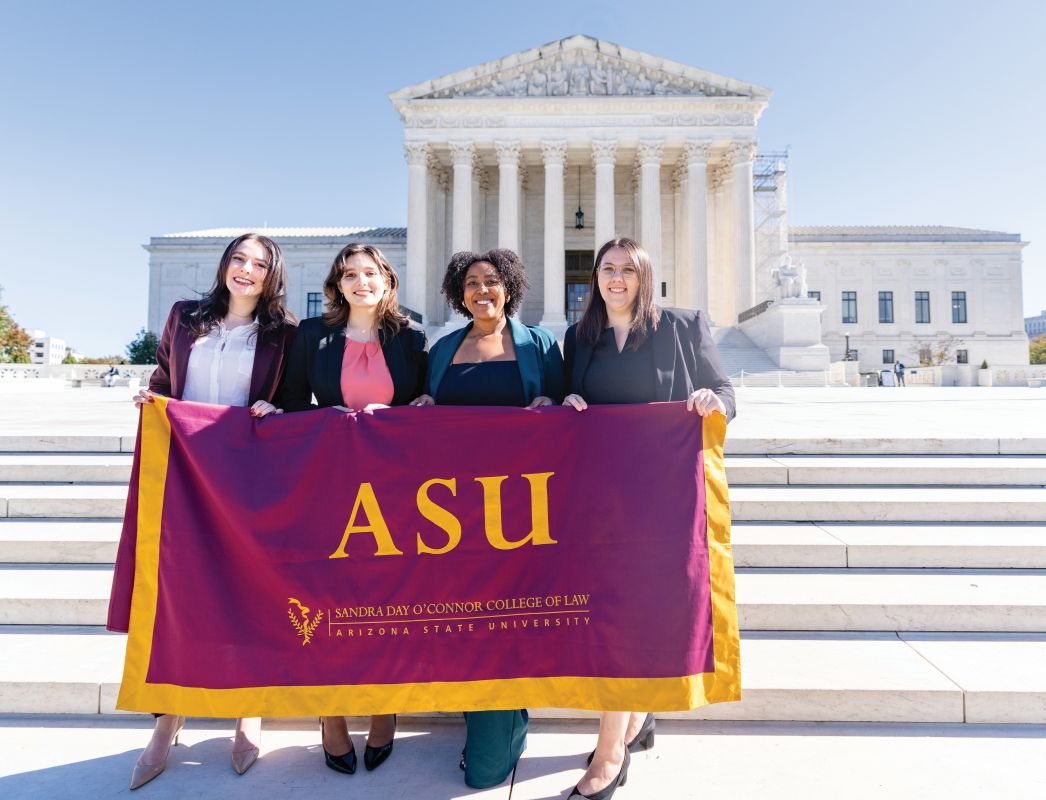
Amy Best, assistant dean of admissions and financial aid at Sandra Day O’Connor College of Law at Arizona State University, advises students that LL.M. coursework “could certainly provide an advantage or an enhancement in the workforce.”
“We will typically talk through their goals and what they’re hoping to gain by obtaining an LL.M.,” Best explained. “We have been recognized for the return on investment in our LL.M., and that’s something that we’re very proud of.”
ASU Law’s LL.M. program lets students choose from more than 250 courses to gain 24 credits of instruction in specializations such as biotechnology and genomics, global legal studies and tribal policy. Students can start in the fall or spring, go part time or full time and choose whether to complete all the coursework in one academic year or over three to four semesters.
A fully online version of ASU Law’s LL.M. program is only open to international students, but the online LL.M. doesn’t qualify those students to sit for a U.S. bar exam.
“The customization is something that draws students to our program because they can really take the degree in the direction that they’re hoping to go because they have access to all of the ASU Law courses, which provide a lot of different ways to focus in on different practice areas as part of the degree,” Best said.
While the LL.M. program is small — typically just five students are enrolled each academic year — ASU Law is also known for its low student-to-faculty ratio, at just 7:1.
ASU Law’s long-established programs in law, science, innovation and tribal policy make it a standout for lawyers looking for unique specializations.
“We have great faculty reputations in those spaces,” Best said. “Where we have the expertise, we will work to provide opportunities to students.”
The campus location is also a draw for LL.M. students, she said. Phoenix has become a technology hub — dubbed the “Silicon Desert” — so students are increasingly interested in ASU Law’s biotechnology, patent, business and corporate law classes. ASU Law also has a Washington, D.C., location where LL.M. students can pursue global legal studies in the nation’s capital.
Where the work is
Proximity to global technology and energy corporations is also a contributing factor for lawyers considering an LL.M. degree from University of Texas School of Law in Austin. Marketed as “Silicon Hills” by regional boosters, Austin has welcomed Google, Apple, Meta and Tesla facilities in recent years, boosting the area’s depth of industries.
LL.M. concentration options at Texas Law include business, cybersecurity law, human rights and a much-coveted global energy, international arbitration and environmental law specialization.
Natalie Shields, senior admissions coordinator of graduate and international programs at Texas Law, said prospective LL.M. students are often impressed with the flexibility and interdisciplinary nature of the law school’s LL.M. program.
“In the feedback we’ve got from students, they say, ‘We’ve never seen an energy, international arbitration and environmental law concentration. I want to do all of them!’” Shields said. “They were like, ‘This is actually ideal because I want to be able to use those skills in my career.’ So that’s pretty cool.”
The law school’s LL.M. program is intentionally selective, with just 25 spots offered each academic year. It’s a full-time degree program that runs August through May. There are no spring start options and no online classes.
“Because we are a smaller class, we’re very, very involved with our students,” Shields said. “We organize events for our students separate from what the J.D. program is doing. We’re very kind of close-knit.”
While the LL.M. program is scaled small, students can participate in larger initiatives at Texas Law, including the Strauss Center for International Security and Law. The multidisciplinary research center focuses on national security, international law, cybersecurity, intelligence, technology policy and global affairs, bringing together academics, policymakers and industry practitioners.
“For our LL.M. students, the Strauss Center is an example of the broader opportunities available at U.T. to engage with cutting-edge legal issues beyond the traditional classroom,” Shields said.
LL.M. students can also get hands-on experience through internships, legal clinics and moot court and mock trial competitions.
The LL.M. program at Texas Law is largely comprised of international students. Shields has been in their shoes — originally from London but residing in Austin, she graduated from the law school’s LL.M. program in 2019 with a specialization in U.S. law for foreign lawyers.
Beyond studying for state bar exams, the LL.M. gave her a year to learn about U.S. laws while also sampling classes in human rights and business law.
“Our concentrations are very flexible. You can tailor it to your own needs,” Shields said. “This is your only opportunity to take those kinds of subjects you enjoy.”
Team learning
Joly at Georgetown Law said LL.M. programs in the U.S. are becoming more interdisciplinary to reflect the demands of the current legal workforce.
“All of the different ways in which the practice areas overlap in the real world are then reflected in the curriculum,” Joly said. “As higher ed, we’ve done a good job over the last few years, I think, of really expanding access for the students to all these different methods of learning and a lot of those reflect real-world experiences and skill building.”
Georgetown Law in Washington, D.C., has about 500 LL.M. students each academic year, with program options including technology law and policy, national and global health law and national security law. Its top-ranked graduate tax law specialization has more than 50 courses available, more than any other program of its kind in the nation.

LL.M. students at Georgetown Law can choose from more than 300 courses, from general studies to the latest in data security, privacy, artificial intelligence and fintech.
“I think the advantage of being a larger program is that we can maintain the bread and butter, foundational classes,” Joey said. “And we are able to offer an evolving menu of up-to-date seminar courses that do reflect the changes in the profession.”
Joly said that Georgetown Law recognizes that LL.M. programs bring together a unique confluence of leaders in their field: lawyers from all over the world with insight into specific practice areas, full-time and adjunct faculty with practical experience and guest speakers with a purview into current industries.
“When we’re looking at developing the curriculum, one of the things that we are taking advantage of and thinking about is that because the LL.M. serves largely mid-career professionals, whether they’re in the U.S. or from abroad, they’re bringing a lot of expertise themselves into the classrooms,” Joly explained. “We look for opportunities where those areas of expertise can intersect so students are learning from the faculty, but they’re really learning from each other too.”
Methodology
For academics, we look at the number of courses offered (15%), and the number of professors (15%). Career opportunities consist of networking opportunities (8%), recruitment programs (8%), and whether there is a dedicated career counselor (14%). Practical training includes whether there is a live client guarantee (7%), externships opportunity (4%), and simulation courses offered (4%). Student offerings include journal participation (4%), moot court participation (4%) and student group options (7%). We reserve (10%) for other.
